Saturday, September 25, 2010

Paper Because.....

Following on the heels of a post this past week on the Paper Planet discussing Domtar's decision to join the Two Sides campaign, a new website targeting the North American market was launched, called "Paper Because."

In what appears to be a much more reasonable, and thoughtful approach, Domtar is promoting the special attributes of paper, as well as suggesting there are efforts paper producers can and must take to become ever more sustainable.  The first impression is that it is more reflective of their efforts to work with conservation groups such as WWF, Rainforest Alliance and the Carbon Canopy project, and their growing use of FSC fiber.

There are some good points, including on social benefits of paper:
Jakob Nielsen, a web usability expert noted that: “The online medium lends itself to a more superficial processing of information, you’re just surfing the information; it’s not deep learning.”1 
On environmental improvement, and superior credibility of FSC certification:
Whenever possible, Domtar favors certification to FSC, due to its inclusive mandate, which involves striking a balance amongst environmental, social and commercial interests in a forest.
However, there's also a bit of misleading environmental information, an attack on recycled paper, and some dodging of the reality of the carbon footprint of making paper, especially in the "Quiz," including,

When it asks if paper is a major contributor to landfills, the website claims the correct answer is, "False," and yet that's simply not true.  The US EPA and the facts disagree.  Yes, we recover and recycle a lot, and at a higher percentage than other materials, which is great.  However, paper is still the single largest component of the wastestream and even after recycling, its the largest contributor to our landfills, constituting about 25% of the waste goes into landfills, more than any other single product. (Municipal solid waste in the United States: 2005 facts and figures. www.epa.gov/msw/msw99.htm)

It just shows how massive the volume of paper we use is, and that to reach sustainability we are going to have to be a combination of (1) more responsible in making it and managing where it comes from (2) more efficient in using it and (3) find continued success in growing our recovery rate for paper.

In the quiz you will also find many of the same old forestry facts that sound good but don't really mean much, such as, "There are nearly 750 million acres of forests in the U.S. — about the same as 100 years ago. "


And many attempts are made in the quiz to claim that burning wood and other tree-byproducts are "carbon-neutral", a dangerous assumption that science has proven to be false, but federal and international policy is still working to catch up with.  We can't have a reasonable discourse on how to properly account for the carbon emissions released to the atmosphere in this process, when critical stakeholders flat-out deny any responsibility whatsoever.

We all buy paper, and when we do, I hope we buy "paper because" it is the best performing or only viable medium for the application required, and because it was made by a leadership company using the most environmentally responsible production possible.  (Learn more about environmentally superior papers at WhatsInYourPaper.com)

Visit the site, Paper Because, to see what its all about yourself.  Tell us what you think.  Share your favorite clip from the site based on either its truth about the benefits of paper or its dubious environmental claims.

Groups Plan 2011 Day of Action to Stop GE Trees

In 2004, September 21st was declared the International Day Against Tree Monocultures by organizations throughout the world. On this day, people in every continent carry out actions to generate awareness about the impacts of large scale tree monocultures on communities and their environments.

This past week on September 21st, 2010, in the United States, there was an urgent focus on the looming threat of genetically engineered eucalyptus tree plantations, being pushed aggressively, and many say quite recklessly, through the regulatory approval process.

The Dogwood Alliance's Executive Director, Danna Smith said, "The USDA recently approved a request by GE tree company ArborGen, headquartered in South Carolina, to plant over a quarter of a million genetically engineered eucalyptus trees across Florida, Georgia, Alabama, Mississippi, Louisiana, Texas and South Carolina, -many of the same regions still trying to recover from Hurricane Katrina and the Gulf oil spill. This would be another disaster for the region."

On July 1, 2010 Global Justice Ecology Project, Dogwood Alliance, Sierra Club, Center for Biological Diversity, Center for Food Safety, and the International Center for Technology Assessment filed a lawsuit challenging the USDA's decision in order to stop ArborGen's GE eucalyptus plantings.  The case is pending.

Dogwood Alliance and its allies in the Stop GE Trees Coalition released a short video, embedded below, which makes the case quite persuasively that common sense and good scientific ethics dictate the need to slow down, and halt the introduction of what are commonly known as "Frankentrees."   In it they call for a political  "day of action" in 2011 to bring additional attention and energy to the campaign.  

Those concerned may sign a petition to join their voice to the effort.


Thursday, September 23, 2010

Most Finance Execs Looking to Increase Efficiency, Reduce Paper Use

J.P. Morgan Treasury Services, sponsor of Treasury & Risk's first annual Going Green survey, found that approximately 80% of the more than 200 finance executives surveyed say green strategies or sustainability efforts have saved or are expected to save their company money. Approximately 79% of these executives expected to see increased efficiencies if they were to shift to a completely green treasury operation. Certain green strategies are quite popular, including converting paper-based treasury processes to electronic transactions, which was cited by 71% of participants.


"Migrating to electronic Treasury processes can have a measurable impact on a corporation's carbon footprint as large treasury operations can easily generate 5.5 tons of paper each year--the equivalent of 143 trees and 106 tons of greenhouse gasses," said Susan Webb, managing director, J.P. Morgan Treasury Services. "We sponsored this survey to highlight the benefits of establishing a completely green treasury and help bring greater focus to what role finance executives can take in improving corporate sustainability efforts."


"In addition to environmental concerns, today's economic climate is making it even more essential for treasury departments to go green," observed Gregory Long, Vice President, J.P. Morgan Treasury Services. "Many face tremendous pressure to trim costs, operate more efficiently and improve customer service. Electronic solutions help businesses automate workflow, give them instant access to financial data and eliminate the costs and risks of producing and storing paper."


J.P. Morgan Treasury Services began its own "Go Green" campaign in 2007. Since then, the Bank has helped treasury clients eliminate more than 101 million paper documents and save three million pounds of paper annually. In addition, J.P. Morgan clients report that the Bank's Web-enabled image technology has helped improve efficiency within their own treasury operations. For example, clients have decreased the amount of time needed to identify and resolve exceptions; manually enter data into accounts receivables or payables systems; manage, store and retrieve paper documents from on and off-site storage facilities; and research and respond to internal and external requests.


J.P. Morgan has made available more survey results can be found online at www.treasuryandrisk.com and a free white paper, Sustainable Treasury Management: It's Easier Than You Think


J.P. Morgan will be presenting a free webinar with its client AXA Equitable on Wednesday, October 13th at 2 pm ET titled "The Road to Green Treasury is Paved in Dollars Saved." Register Here

At the Paper Planet, we applaud this efficiency effort, and encourage businesses to incorporate these strategies.  Cost savings can in part be applied to implement other green initiatives, such as purchasing of environmentally responsible paper for purposes where it is still needed.  It is also important that J.P. Morgan and other businesses look honestly at the impact of energy used to power electronic transactions and data storage, and account for those impact as well, so that similar ingenuity can be applied to reducing the environmental footprint of that activity.

Tuesday, September 21, 2010

CU-Boulder Greens their Paper

The Paper Planet applauds the commitment of CU - Boulder to purchase a minimum of 30% recycled content paper. In an effort to continue aligning campus sustainability initiatives with the Governor's "Greening of the State Government" executive order of 2007 and to meet campus goals, Staples will work with all departments on campus to substitute virgin paper orders with recycled paper of 30% or greater recycled paper content.

Greening the process by substituting recycled paper was proposed by members of the Zero Waste Sustainability Action Team. The Boulder campus is already well on the way to using only recycled paper. About 78% of paper purchased in FY 2010 contained a minimum of 30% recycled content.

The University has committed itself to attaining the goals set for 2012 by the Governor's Energy Office to reduce paper use by 20%. This change to 30% recycled paper will not only help the campus reach this goal, but is in line with the greener campus culture that is desired.

During FY 2010, a variety of departments and staff on the Boulder campus made independent decisions that shifted paper purchases from primarily virgin paper to paper with a recycled material content of between 30% and 100%. The switch from virgin to 30% recycled may seem small but will move the campus steps closer to state and campus goals, and overall environmental health.

Once again, individuals that make up the campus community have demonstrated a commitment that has made CU-Boulder a national environmental leader. Their efforts are commended and the Paper Planet hopes to see many more campuses follow suit in the near future.

Domtar's Two Sides of the Atlantic

News came this week that Domtar has become the first North American company to join the Two Sides campaign, a UK based organization funded by some in the industry to promote wasteful consumption of paper products, more costly ways of doing business, such as its active campaign to eliminate the "don't print" reminder at the bottom of emails. Its not exactly the kind of leadership our "paper planet" needs.


Its unfortunate, because apart from its aversion to recycled fiber content, Domtar is generally regarded as an environmentally conscientious company, and has been a leader in many ways in the past decade. The Two Sides campaign on the other hand, actively promotes a fairly outdated perspective and anti-conservation views. On its webpage, for example, under its Q and A, is included a question stating,
"When they promote the use of FSC/PEFC automatic they send a negative message to the general public, because it appears that all remaining fibers are not completely sustainable." and the
Two Sides answer is, "I quite agree.
It is Two Sides' ambition to ensure that public perception now sees print media as a natural product that can be used with complete confidence."
The perspective that all paper fibers can be assumed "completely sustainable" even without third-party certification is an extreme point of view pretty far out of the mainstream marketplace in 2010 and unsupported by the facts and the science.

Don't think, just print. Don't be efficient, just print. Don't consider your brand, just print. That seems to be the message.

No one can blame Domtar or other companies for wanting to sell paper (in Europe), and make a living. But the Paper Planet would like to encourage Domtar to step back and consider an approach we believe will be more effective, and save everyone a lot of money and healthy forests.

Even conservationists recognize paper's got a lot going for it, and plays an important role in our lives. Just like digital devices, paper isn't going to vanish from our lives, and shouldn't. But encouraging wastefulness will never fly, it will never be leadership. Could it be that the industry would find more success through authentic environmental responsibility and by selling paper's unique characteristics, experience and applications, rather than marketing wastefulness to simply increase volume and number of units sold?

The essay, Paper, Paper, Skin and Body, by David Barringer on paper's virtues and its affect on us in our lives, offers a window for inspiration. It is obviously art, poetry, not marketing, but it gives an insight into how to highlight the unique attributes and experience that comes from paper, and lead us to value it more. It is through this higher value for paper, which includes incorporating transparent, authentic responsibility to the people and the land where it comes from, that there is opportunity for a viable paper industry in the unavoidable reality of decreasing consumption in developed countries.

What are your thoughts about Domtar joining the Two Sides campaign?


Thursday, September 09, 2010

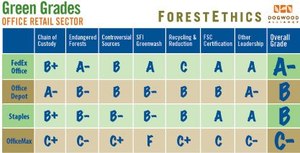
Office Supply Companies Get their Green Grades for 2010

As students go back to school, Dogwood Alliance and ForestEthics released their annual Green Grades report card today, While the sector saw overall progress on critical sustainability issues such as Endangered Forest protection, several prominent brands continue to earn poor marks from conservation groups.

Now in its 4th year, the Green Grades report card informs American consumers and large purchasers of paper products on what companies are doing--or not doing--to safeguard the environment and the world's forests.

While FedEx Office, Staples and Office Depot continue to lead the pack, according to the report other companies such as Amazon.com, Costco and xpedx continue to fall short on critical questions about the sustainability of their products and processes. In the middle are companies such as Target and PaperlinX, each of which are adopting new green paper purchasing policies, representing important progress toward really making the grade.

The 2010 Green Grades features a new category, SFI Greenwash, to address rampant use of the Sustainable Forestry Initiative's phony eco-label on office supply products. Conservation groups assert that SFI labels and certification provide "green" cover for harmful practices such as large-scale clearcutting, Endangered Forest logging, and conversion of forests to sterile tree plantations.

"It's a shame that some US wood and paper producers are spending millions to mislead consumers with SFI marketing," said Daniel Hall of ForestEthics. "That money would be much better spent on protecting remaining natural areas and endangered species' habitats, and restoring watersheds hard hit by years of excessive industrial logging."

This edition marks the fourth straight year that environmental groups Dogwood Alliance and ForestEthics have collaborated on Green Grades, and the report card has helped catalyze considerable progress by the sector over the years. For example, this year's grades reflect a growing commitment to protecting Endangered Forests around the globe and increased scrutiny of the impact of company paper habits on global climate. There is also an increased commitment from a number of companies to better practices via use of the Forest Stewardship Council (FSC) certification system.

Monday, August 16, 2010

Open Forum on Taxpayer Subsidies for Burning Black Liquor

This Sunday there was article in the Mobile (Alabama) Press-Register that continued to illuminate the real world implications of the confusing and troubling story of the paper industry's second big windfall in the past year from taxpayers for continuing to burning its black liquor waste. (Article from Mobile also has a good summary of how we got here, in addition to the interest new case studies)


The conservation community, acting in defense of taxpayers, recycled pulp and paper manufacturers plus their mill employees, and common sense, strongly disagrees with the IRS's recent overruling of the US Environmental Protection Agency's (EPA) determination that black liquor does NOT qualify for this second tax incentive, the Cellulosic Biofuel Producer Tax Credit. As the Clear Air Act authorizes EPA to handle registration of biofuel producers and to determine if different fuels should qualify, 27 leading conservation groups sent a letter to the EPA late in 2009, and received correspondence in return clarifying the issue. From the EPA's correspondence.....
"The $1.01 cellulosic biofuel producer credit is a tax credit put in place by the 2008 Farm Bill and administered by the Internal Revenue Service. The act's language requires that among other things, in order to qualify as cellulosic biofuel, the fuel must meet "the registration requirements for fuels and fuel additives established by the Environmental Protection Agency under section 211 of the Clean Air Act (42 U.S.C 7545)." These registration requirements are applicable only to motor vehicle gasoline, motor vehicle diesel fuel, and additives for these fuels. Our understanding of black liquor is that it is a byproduct of the paper milling process with the consistency of molasses."
Its clear from the people who know, black liquor doesn't meet registration requirement for a "cellulosic biofuel producer" under the Code.

The article from Mobile helps us start to get more real world information on how each pulp producer will handle the surprise ruling by the IRS, and the new opportunity to cash in on burning their black liquor.

If you are familiar with this issue, you know that some companies will have plenty to keep their accountants busy, because they claimed .50/gallon for all of 2009 already. Some got started adding diesel fuel to the mix late, so they have early 2009 black liquor burning they can claim the 1.01/gallon tax credit outright for that volume. Without the diesel mix, they couldn't fit through the tax loophole. As the article shows, some of the companies, like International Paper, whose consultants had the impressive imagination to find and negotiate their way through this loophole, got a head start and got a cool $2 billion, won't be returning the cash to take advantage of this tax

The Joint Committee on Taxation is currently studying how much this new twist will cost taxpayers, and to be accurate, they would have to take each company's considerations into account. For example, they can not say this will cost taxpayers $2 billion dollars additional for IP, since it is valued at twice as much a gallon for 2009

However, the leadership of the US Senate Finance Committee, Senator Max Baucus and Senator Charles Grassley, would be acting irrationally and irresponsibly not to close this loophole, and to repeat the mistake they made in 2009 by sitting on their hands as the US Treasury bled $8 billion dollars.

What do you think? Post your comments below in this open forum on the black liquor issue.

Friday, August 06, 2010

ChiefExecutive.net Names the Most Anti-Environmental Consulting Firms

The online publication, ChiefExecutive.net, has published an interesting article that reveals that companies that work cooperatively with NGOs to identify environmental and social risks in their supply chain are more successful than companies that do not.
From the article:
Major office-supply retailers move a lot of paper and have had to deal deliberately with challenges by RAN [Rainforest Action Network] and other NGOs over their sourcing practices. OfficeMax Inc, on one hand, has resisted RAN's demands about its foresting practices in Canada and ignored activist protests at its stores, though the Naperville, Ill., company has initiated its own sustainability efforts.
But after displaying similar resistance, archrival Staples largely aceded to work with NGOs nearly a decade ago. And, sure enough, Staples ranked No. 20 last year on Newsweek magazine's environmental ranking of America's 500 largest corporations, while OfficeMax didn't show up.
They also expose the names of some of the most anti-justice and anti-environmental corporate consulting firms who shake down corporate clients by selling them advice on how to fight back against the scientific evidence and consumer outrage brought to their stores by NGOs, through greenwashing, stonewalling, and sowing confusion among the public. Here's a chart from their article:

(click on image to see full view)

Read the full article at ChiefExecutive.net

Tuesday, August 03, 2010

Rainforest Action Network Gets New Executive Director, Its First Woman Leader

Rainforest Action Network (RAN), a member of Environmental Paper Network's Steering Committee and one of the nation’s leading environmental action organizations, has named Rebecca Tarbotton as its executive director. As the first woman to head the organization, Tarbotton joins an exclusive club of women leaders in the environmental sector. Among its multifaceted and effective work, RAN has been a leader in movement to protect old-growth forests from being turned in disposable paper products. They are currently aggressively challenging pulp and paper companies in Indonesia that are converting carbon-rich peatlands and rainforests to plantations and driving species such as the Sumatran tiger and the orangutan to extinction.

“From West Virginia communities resisting mountaintop removal mining to Indigenous groups in Sumatra trying to keep their rainforests standing, people around the globe are seeing the impacts of unchecked corporate power on their environment,” said Tarbotton. “For the past 25 years, RAN has convinced some of America’s largest corporations to value people not just profits. I’m honored to continue this legacy of fearless action as we work to protect rainforests, keep fossil fuels in the ground, and stop climate change.”.

For more, including a video message from RAN's new Executive Director, visit http://ran.org/ed


Thursday, July 22, 2010

The Manomet report

A report by the Manomet Center for Conservation Sciences, commissioned by the Massachusetts state government, was released finding that biomass emissions for energy have real climate impacts. The report contains lots of good insights and shows quite definitively that biomass emissions must be included in our estimates of the climate impact of products, industries or activities. It is an important report and an important advance in the discussion.

That said, the report makes two assumptions that tend to underestimate the impact of biomass emissions and thus under-sell the need for policy changes to take the real impacts of biomass emissions fully into account.

The first is the idea of 'replacement' as the goal of policy. The second is the idea that the comparison of biomass should be limited to fossil fuel emissions. Now, Manomet may have been working strictly under the terms of reference given to them by the Massachusetts state government. But the deficiencies should be pointed out nonetheless.

Replacement. The idea that the use of biomass starts to yield benefits once the forest or ecosystem 'replaces' the carbon once released is the wrong baseline. The forest in question, if left unharvested and not used as biomass, would not be static. It would grow and absorb additional carbon in most cases. Thus, in the period of 'replacement, the forest might go from 50 tons of carbon per unit area (let's say) to more: 60, 75, or some other amount. So, the real impact is greater than the measurement against 'replacement.' Replacement may be a useful measurement tool, like measuring a half-life of radioactivity, but it is not the full impact. If we leave more forests intact without harvest for longer periods, we will tend to have that much carbon and more. That last option is the best option for the climate and is where we should drive policy. (Aside: this policy can also be beneficial to land-owners, since we might enact policies that encourage them to keep their forests intact for longer, such as tax breaks for those doing so, something like the Conservation Reserve Program that is so successful.)

Comparisons of impact. The report compares emissions from biomass to emissions from fossil fuels. It's a useful exercise. But it's not our only option. And we need to make those options very clear so we can decide collectively how to get at the problem in the best way. Our choices are not limited to biomass or fossil fuels. Conservation of energy measures and investing in wind, water and solar options are also on the table, though under-invested in.

Here is what the report presents:

Fossil Fuel Technology Carbon Debt Payoff (yr)
Oil (£6), Thermal/CHP 5
Coal, Electric 21
Gas, Thermal 24
Gas, Electric >90

But a more robust analysis of options might look something more like this:

Alternative Carbon Debt Payoff (yr)
Oil (#6), Thermal/CHP 5
Coal, Electric 21
Gas, Thermal 24
Gas, Electric >90
Wind, Water, Solar ?, >150, >200 ?
Source Reduction 180, >240 ? ">?, >180, >240 ?

As I wrote earlier, these are already underestimates, but leaving out the fact that our best policy alternatives are not referenced is a weakness in the report.

Sincere congratulations to Manomet for advancing the debate, but let's not forget what our best options are: keeping more forests storing more carbon across the landscape for longer periods and swapping out fossil fuels as rapidly as possible for conservation, wind, water and solar.

Friday, July 09, 2010

Are APP and APRIL Undermining Indonesia's Agreement with Norway?

An investigation by Eyes on the Forest has found that two of the world’s largest paper companies, Shanghai-based Asia Pulp & Paper (APP) and Singapore-based APRIL, are undermining the recent agreement between Indonesia and Norway “to contribute to significant reductions in greenhouse gas emissions from deforestation, forest degradation and peatland conversion.”

The two companies together pulped five percent of the remaining natural forest in Sumatra’s Riau Province, twice the size of Indonesia’s capital Jakarta, an analysis of 2009’s annual cutting licenses (RKT) shows that these licenses were issued for the extraction of high timber volumes per hectare. Most of the clearance of these high quality forests occurred on peat soil more than three meters deep in violation of existing law. Draining of peat soil and clearing of natural forests has been the main source of Indonesia’s huge greenhouse gas emissions.

“APP and APRIL are undermining our President’s commitment to reduce the country’s emissions by up to 41 percent. We call on APP and APRIL to immediately stop using any timber associated with the conversion of tropical rainforest and draining of peatlands,” said Ian Kosasih of WWF Indonesia.

Both companies have advertised for years that they would no longer use natural forest fiber for their pulp production by 2009. But Eyes on the Forest estimates that the 2009 permits they acquired to clear natural forest in Riau alone may represent up to 40% and 84% of the raw material needs of APP’s and APRIL’s Riau pulp mills, respectively.

In his agreement with Norway, the President committed to institute a two year moratorium on all new concessions for conversion of peat and natural forest from January 2011. Yet immediately following the commitment, the Indonesian Ministry of Forestry issued new permits to drain deep peat and clear natural forest in Riau. The new licenses may represent up to 29% and 50% of APP’s and APRIL’s Riau mill’s raw material needs. APP and APRIL seem to be in a great hurry to clear Riau’s remaining forests before the moratorium starts, putting the President into a very embarrassing position. To Eyes on the Forest, it appears the announcement of the moratorium has been a signal to clear even more forests, even faster.

The report from Eyes on the Forest finds that APP has been draining peat and clearing natural forests in Riau’s UNESCO Biosphere Reserve while advertising globally its full support for the reserve. APP has been clearing crucial habitats of the critically endangered Sumatran tiger increasing the often deadly conflicts between people and tigers, while widely advertising its contribution to tiger conservation in the same area in this “Year of the Tiger”. APP has been clearing High Conservation Value Forests that it had publicly committed to protect, while promoting its commitment to protect high conservation value forests in its PR campaigns.

The report also finds that APRIL has been clearing High Conservation Value Forests in deep peat areas, which WWF had delineated and the company had agreed to protect. By doing so APRIL broke the agreement with its international auditor, Rainforest Alliance’s SmartWood Program, who suspended the company’s FSC Controlled Wood certificate.

Learn more.....


Friday, July 02, 2010

Groups Sue to Stop GE Trees Release in Southern United States

An alliance of conservation organizations today sued the U.S. Department of Agriculture over its approval of open-air field tests of a genetically engineered (GE) hybrid of eucalyptus tree across the southern United States. The permit, issued to a company called ArborGen, which is a joint initiative of International Paper, MeadWestvaco and Rubicon, was approved May 12 with minimal environmental review. It authorizes the experimental planting and flowering of a new, genetically engineered hybrid on 28 secret sites across seven southern states — Alabama, Florida, Georgia, Louisiana, Mississippi, South Carolina and Texas.


“In refusing to prepare a detailed environmental review, the Department of Agriculture ignored serious risks before permitting this action,” said Marc Fink, an attorney with the Center for Biological Diversity. “Federal agencies can’t be allowed to neglect their duty to the public trust. Once this genie is out of the bottle and escapes to neighboring lands, it’s irreversible.”


ArborGen hopes its GE “cold-tolerant” Eucalyptus will become widely planted for pulp and biomass. But eucalyptus trees are not native to the United States and are known to become invasive, displacing native wildlife and plants in various areas around the country and increasing wildfire risk. “Releasing GE cold-tolerant Eucalyptus trees into the wild in multiple states greatly increases the risk they will spread uncontrollably throughout the region,” said Dr. Neil Carman of the Sierra Club.

In approving the GE eucalyptus permits, the Department of Agriculture ignored the concerns of numerous agencies and scientists, including the Georgia Department of Natural Resources and the Florida Exotic Pest Plant Council, which formally criticized the proposed open field tests of these genetically engineered trees.

In addition to approving these test sites, Agriculture is also considering a “deregulation” petition submitted by ArborGen that would allow widespread commercial planting of GE Eucalyptus without any limits or regulation. According to the U.S. Forest Service, GE Eucalyptusplantations in the southern United States would use more than twice the water of pine plantations in a region already suffering from a depleted water supply.

The Government Accountability Office and USDA inspector general have both issued sharply critical reports on the USDA’s management of genetically engineered organism (GMO) field tests. In 2006, a GE rice field test contaminated southern U.S. long-grain rice fields, causing billions in losses to farmers; in 2007, a federal court found that a GE bentgrass field test had contaminated a protected national grassland in Oregon. “The Department of Agriculture continues to tell the public that no further restrictions are needed on these novel organisms,” said George Kimbrell, an attorney for the plaintiffs. “In light of history, their empty promises here ring hollow.”

To read comments submitted by Georgia Department of Natural Resources, click here.

To read comments submitted by the Florida Exotic Pest Plant Council, click here.

The organizations that filed suit today are the Center for Biological Diversity, Sierra Club, Dogwood Alliance, International Center for Technology Assessment, Center for Food Safety and Global Justice Ecology Project.


Tuesday, June 08, 2010

Gucci Unveils Steps to Meet its Eco Promises


Gucci has announced the launch of a worldwide eco-friendly program designed to progressively reduce the company's impact on the environment, which includes following through on a commitment it made to Rainforest Action Network in November.

The centerpiece of this new initiative is packaging newly designed to reduce materials, exclusively use FSC Certified paper and to be 100% recyclable. The initiative will be introduced in all of its 284 directly operated stores around the world from June 2010. The new packaging concept not only represents an important action towards environmental responsibility, but also reinforces Gucci’s heritage as the company approaches its 90th anniversary in 2011. It is within this dual context that Gucci’s new packaging has been conceived by Gucci Creative Director Frida Giannini pairing past with present and luxury with responsibility.

Patrizio di Marco, President and CEO of Gucci, said: “The world's leading brands are rightly judged today not just on the quality of their products and services, but also on the way they act in the community and towards the environment.

Gucci has committed that by the end of 2010 all of its purchases of non-recycled forest products will be Forest Stewardship Council (FSC) certified products to ensure that no paper is being sourced from endangered forests including the rainforests of Indonesia, one of world’s hotspots of deforestation and climate change. Furthermore, it will continue to seek alternative fiber options to use in its packaging products, include biodegradable bags made of corn, bamboo and cotton.

Through these various initiatives Gucci aims to achieve the following targets by the end of 2010:
- a reduction of 35 tons of plastic waste;
- a reduction of 1,400 tons of paper consumption (coming from the implementation of the new packaging, the replacement of a cardboard box with a recyclable bag and the optimisation of paper consumption from catalogs and promotional materials);
- a reduction of about 10,000 tons of Co2 emissions;
- a reduction of about 4 million liters of gas oil consumption.

Lafcadio Cortesi, Forest Campaign Director of the Rainforest Action Network (RAN) an Environmental Paper Network member, commented, "We are impressed with Gucci's actions to improve its environmental footprint. The company’s decision to reduce its paper and wood consumption and only buy FSC Certified products will help protect Indonesian and other endangered forests around the world and sets an example for other companies in the luxury sector.”

Friday, June 04, 2010

Green Freedom? Really?

When I recently saw the logo of the new astroturf organization called, "Green Freedom," I honestly wondered if it was a joke. Its clenched fist/leaf just seemed too over-the-top, maybe even something out of a satirical article in the Onion.

But no, its a well funded and serious effort to confuse the public and discredit environmental NGO's around the world, as a means to protect the agenda of expansion and unconstrained exploitation of land and people by multinational corporations, particularly in the global South.

I think this article from June 2nd by Peter Nowack is a good summary of not only Green Freedom, but a fuller picture of an uncanny emergence of several such organizations simultaneously. Mr. Nowack says,

"In the last few weeks, pro-industry organizations here in the US, in Indonesia, and in the EU have been awakend from their slumber and are ramping up their rhetoric against Environmental Non-Profit Organizations (ENGOs) which seek to bring an end to deforestation and landscape-scale conversion of biologically diverse forestlands into monoculture plantations."
Read the full article here.....

Tuesday, June 01, 2010

VIDEO: Breakthrough in Tasmanian Struggle over Gunns Ltd. Pulp Mill

Environmental Paper Network members The Wilderness Society - Australia (TWS), would like to share a video announcing a major breakthrough in their work to achieve protection for ancient and endangered forests in Tasmania. If you've been following it or are a party involved, you know this hotspot has been one of the most urgent struggles in the story of the social and environmental transformation of the pulp and paper industry.

The Wilderness Society is now announcing....

"John Gay and Robin Gray have been forced to step down from the Board of Gunns Ltd and will no longer have any further involvement with the company or its subsidiaries.

This is fantastic news for Tasmania's precious forests - it now creates the opportunity to achieve permanent and lasting resolutions to the conflict over forestry in Tasmania."

Watch the video here.....