Monday, March 07, 2011

Another Canadian Mill Sold to Notorious Asia Pulp Paper


Greenpeace is concerned about the negative impact on the Boreal Forest in Saskatchewan that will result from the sale of Domtar’s Prince Albert mill to a subsidiary of Asia Pulp Paper (APP).  APP’s subsidiary Paper Excellence has been on a buying spree, scooping up prime Canadian pulp assets in British Columbia and Saskatchewan and shipping jobs offshore.  The majority of the pulp produced by the company’s other three mills is shipped to China for processing into paper products.

Greenpeace Canada forest coordinator Richard Brooks issued a statement today, saying, “It is a great concern that Canadian mills are being bought up by Asia Pulp and Paper, one of the most destructive logging and pulp and paper companies operating anywhere.  APP is the primary contributor to making Indonesia the third largest emitter of greenhouse gases on the planet. We urge the Saskatchewan and federal governments to investigate APP which has been involved in illegal logging and deforestation in Indonesia for decades and continues to be involved in conflicts with local communities there. APP is also a debt-ridden company. Do we want that kind of company as a major player in Canada’s forest products sector?”

Richard Brooks is available for interviews at (416) 573-7209

Background provided by Greenpeace:

The destruction of rainforest and carbon-rich peatlands is the key reason for why Indonesia accounts for around a quarter of all greenhouse gas emissions caused by deforestation. The palm oil and pulp and paper industry are the two major drivers of these escalating emissions. The endangered orang-utan and Sumatran tiger are just two of the species under threat of extinction due to habitat loss caused by Asia Pulp and Paper.

Asia Pulp and Paper, the ‘family treasure’ of the Sinar Mas Group and the notorious Widjaja family, defaulted on more than $14 billion of debt during the Asian financial crisis in the 1990s. It was saved by suspicious government financed ‘restructuring’.  At the end of 2009, APP’s Indonesian mills still owed $4.2 billion of restructured debt.

Major forest products companies Office Depot, Staples, Xerox, Ricoh, and Target have all cancelled contracts with APP over risks to their brands of using APP products and over APP’s links to deforestation. APP is subject to a global campaign by Greenpeace and other environmental organizations.

Learn more about how Sinar Mas Group is “Pulping the Planet.” 


Tuesday, February 22, 2011

Cascades Brings Two New Eco Papers to North American Market

Cascades Fine Printing Group of Quebec, Canada has developed two new papers that will qualify for listing on the Eco-Paper Database, an independent designation for the highest product leadership in environmentally responsible papers, developed by a coalition of environmental organizations.   The new papers are Rolland Enviro100 Satin and Cascades Enviro Kraft Print, both for commercial printing, and both contain 100% recycled content.

The Rolland Enviro100 Satin is manufactured using local biogas energy, contains 100% post-consumer fiber, carries certifications from Forest Stewardship Council (FSC), EcoLogo, and is certified Processed Chlorine Free.

Cascades Enviro Kraft Print is 100% post-consumer recycled and is FSC and EcoLogo certified.

Learn more about Environmental Paper Network's - "Paper Steps" - A guide developed by a large coalition of conservation organizations to designate leadership in environmentally responsible paper products across multiple attributes, including recycled content, FSC certified fiber, bleaching process, and incorporation of agricultural residue fiber.


Monday, February 21, 2011

GeaSphere Files Complaint on Baboon Killing in South African Timber Plantations

The controversial, deadly and ineffective methods of protecting tree plantations from baboon damage in southern Africa is making headlines this week.  Mongabay.com reports, 

The African environmental group, GeaSphere, has lodged a complaint with the Forest Stewardship Council's (FSC) for certifying tree plantations as sustainable that are culling baboons in South Africa, as first reported by FSC-Watch. The primates are trapped with bait and then shot. According to the complaint, "unofficial numbers from reliable sources state that more than 1000 baboons have been shot over the past 2 years" in Mpumalanga Province.  
From the GeaSphere press release:  
The environmental pressure group GeaSphere submitted a formal complaint to the FSC – Forest Stewardship Council – on Tuesday, 11 January 2011. 
At least 1,914 permits to ‘remove’ baboons by a controversial ‘trap and shoot’ method by FSC Certified plantation companies have been issued by the authority during the past two years. Most of the affected troops were from the Sabie, Graskop and Blyde River areas in Mpumalanga province, South Africa. 
GeaSphere is demanding an immediate moratorium on the killing of baboons by FSC certified companies and the de-certification of plantation companies involved in this practice. Baboons are a integral part of our environment. They perform various vital functions, such as dispersing seed of indigenous plants they naturally eat. Very little data is known about baboon dynamics in our area, or the long term consequence of removing baboons in such large numbers. 
Baboons damage pine trees by removing patches of bark reducing the value of the timber and in some cases killing the trees – causing financial losses to the plantation industry. This problem was first reported in 1975, and ever since the timber industry was at war with the baboons.
 John Scotcher, FSC contact person in South Africa, told mongabay.com that,
.....the baboon culling did not go against any FSC regulations. Furthermore, Scotcher said that the FSC was aware of the culling prior to GeaSphere's complaint. 
The complaint has been formally accepted by the FSC and will now be examined by an independent panel. 
"Nobody from the FSC may be a member of the panel. [The panel] will consider the complaint and their findings will be binding on both the complainant and FSC," Scotcher explained. "If the panel identifies any transgressions of local laws or the FSC Principles and Criteria, then there may be a corrective action required from the affected companies."   
More information can be found at the Baboon Information Package on GeaSphere's website.


Tuesday, February 15, 2011

EPN Statement: Forest Carbon Counts

EPN Statement on EPA’s Important First Step to Measure Carbon Pollution of Biomass Energy Produced by the Forest Products Industry

Environmental Paper Network Director, Joshua Martin, issued the following statement regarding EPA’s decision to delay for three years the regulation of CO2 pollution from biomass energy under the Clean Air Act pending scientific study:

“The Environmental Paper Network (EPN) understands that a reliable, accurate and complete accounting of the carbon dioxide pollution from the use of forests for energy production and as fiber for paper products is critical to sound climate and energy policy and to advancing environmental progress in the pulp and paper industry.  The forest products industry is the leading producer and user in the United States of biomass energy and its associated pollution.  Due to the urgency of the climate crisis and the impact of this decision on the sustainability of our nation’s forest resources, we look forward to a scientifically rigorous analysis as the EPA undertakes a three-year delay to conduct its study on regulating carbon dioxide pollution from biomass energy.

“EPN applauds EPA’s previous interim determination on biomass energy in the development of its Tailoring and Tailpipe Rules.  This decision, which set up a separate study process for biomass sources, affirmed that there was ample evidence that biomass energy could not credibly be declared ‘carbon-neutral.’  Now, this three-year study of the scientific evidence will finally put to rest the dangerous myth that harvesting forests for energy and paper production is ‘carbon-neutral.’

“This decision on measuring the carbon dioxide pollution impacts from burning trees for energy is a critical priority for many local communities, for our nation’s forests, and the planet’s climate.  The central issue is proper accounting so that sound decisions can be made to safeguard the public interest and establish fair rules of the game for business.  These fair rules will stimulate and encourage stalled investment in technology in the paper industry to increase competitiveness and job creation in the global, low-carbon economy. 

“The Obama Administration’s EPA must utilize the best science and avoid politics and the hard lobbying that we have already seen from those with a special interest in perpetuating the 'biomass is carbon neutral' myth.  As EPA Administrator Lisa Jackson has said publicly in the past, ‘Science must be the backbone of what EPA does. EPA's addressing of scientific decisions should reflect the expert judgment of the agency's career scientists and independent advisers.’

“The Environmental Paper Network stands ready help the public, business leaders, and conservation organizations provide scientific input to this study and to work with EPA through the process.”

# # # 

The Environmental Paper Network brings together a diverse coalition of environmental non-governmental organizations to accelerate environmental transformation in the pulp and paper industry.  Learn about the work of our members at www.environmentalpaper.org.

Media Contact:  Joshua Martin, 828-251-8558, Joshua@environmentalpaper.org

Monday, February 07, 2011

Are pulp & paper industry consultants distracting the public?

The Paper Planet welcomes a guest column by Aaron Sanger, Director of U.S. Campaigns at ForestEthics, in response to "Are environmental campaigns misleading the public?"
-----------------------------------------------------

At the end of last year, pulp and paper industry consultant Phil Riebel wrote a blog post for RISI posing the provocative question “Are environmental campaigns misleading the public?” Riebel’s main point is that paper products should be evaluated across their entire life cycles, and not on only one environmental impact point such as fiber content.

ForestEthics couldn’t agree more: paper products should be assessed across their entire life cycle and environmental impacts should be minimized at each stage of the cycle.

However, ForestEthics’ expertise is focused on a specific part of a paper product’s life cycle: the one that potentially destroys the forests we need for clean air, water and healthy life of all kinds.

And as a matter of fact, ’fiber content’ features prominently as one of Riebel’s “Ten Ways to ‘Green’ Your Paper”.

But here lies the hypocrisy: If you’re going to recommend fiber-assessing certification and eco-labels as part of a plan to ‘green your paper’, you should recommend those that are truly green and not those that are just greenwashing, such as SFI.

If a certification is going to do its job, and give the consumer information that is relevant to the life cycle, it should have all those things that the ‘Sustainable Forestry Initiative’ (SFI) lacks: full and transparent chain of custody information, rigorous standards that aim higher than ’business as usual’, restrictions against clear-cutting, protections against the destruction of old-growth forests, legitimate audits, and adequate caution with regard to practices which may harm rare wildlife.

In other words, SFI’s labels lack credibility. SFI: Certified Greenwash, the report ForestEthics released last November, has all the details.

If you go ahead and recommend SFI despite its lack of these fundamental components, what’s the point? The life cycle of a paper product can’t possibly be green if the ‘fiber content’ isn’t green. And promoting all ‘certification and eco-labels’ as a ‘sign of environmental commitment’ isn’t a way to green paper products; it’s a tip for how to greenwash.

In a sequel post published a few weeks ago, Riebel reiterates his position that “the key certification systems [including SFI] can be effective tools to achieve sustainable forest management.” We disagree, and our report demonstrates that SFI suffers from inherent flaws that prevent it from being an effective tool to protect forests.

Riebel also claims that each certification system’s performance varies depending on where it is applied, and that the differences between certification systems are not “black and white.” We’ve never said the difference between SFI and other systems is ‘black and white’. We are saying that, based on SFI’s overall failure to protect our forests, its claim that it is ‘good for forests’ is greenwash.

Thursday, February 03, 2011

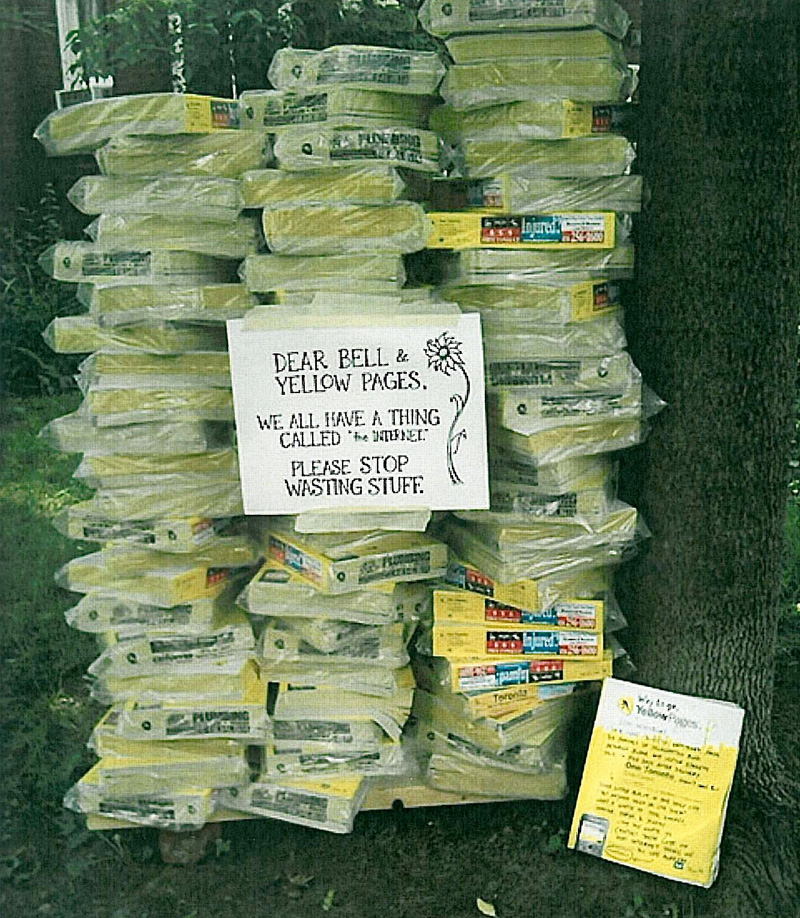
A Blizzard of Action and News on Yellow Pages Waste Reduction

San Francisco and Washington state introduced legislation last week in order to address the environmental and financial impacts that phone books are having in those communities.  The industry has responded by making efforts to improve its current, voluntary, opt-out program.  A central part of these efforts was to create a single clearing house for users who wish not to receive a phone book to go to, instead of the old website which directed users to a phone number of their local distributor after a zip code was entered.  

The new site was launched this week at YellowPagesOptOut.com, and though it was crashed for a day or so, presumably because so many people want out, it appears to be back up and online today.

Here's a round up of the current storm of phone book waste reduction news.


San Francisco’s Opt-In Legislation and an accompanying news piece.

An article on the industry's efforts.

Scott Cassel of the Product Policy Institute, a member of the Environmental Paper Network, has written a great article that addresses the phone book issue.

And on Gizmodo.com, this blogger let's us know how he really feels, in the posting, "At Last, You Can Send the Yellow Pages to Hell"

And if you don't feel like reading, here's an ABC News video segment:


Friday, January 14, 2011

New U.S. Congress May End Mandatory Daily Printing of Legislative Bills

Roll Call, the newspaper of Capitol Hill, reported yesterday that Representative Chris Lee, a Republican from New York, has introduced legislation that would end the mandatory printing of legislative bills by the Government Printing Office (GPO).

This legislation, if enacted, could save the government between $25 and $35 million dollars over the next decade.  And by eliminating the redundancy of automatically having the bills published online, and in print, it would significantly help reduce the daily environmental footprint of the Congress.

The Government Printing Office serves a vital role to the functions of Congress, but there are many common sense opportunities, such as this, to use resources more efficiently.

Currently, according to long-standing practice, the GPO ensures that each sponsor and co-sponsor of every bill receives at least 5 hard copies of proposed legislation, regardless of the bill's length.  Copies are also delivered to the committee responsible for the bill.

From the article,

"Lee likened the process to the infamous Congressional ice-bucket tradition. Offices used to receive buckets of ice each morning, an unquestioned practice that started “before the advent of the refrigerator” and continued, “although unnecessary” until 1994, Lee said.
“This is the next ice bucket,” he said."
Government leadership on the issue of paper use efficiency is to be welcomed.  It is very intentionally the first pillar of Environmental Paper Network's Common Vision, a roadmap to sustainability in paper production and consumption with broad endorsement.  Many leading corporations are realizing the necessity and benefits as well, such as Sprint, who just announced an ambitious goal to reduce paper use by 30%.   For some good ideas on paper use efficiency and more case studies, download a fact sheet here.

Let's hope that efforts such are these are carefully considered in order to maintain the transparency essential to open government, and embraced and expanded by the new Congress.  

What do you think about this proposal?

Tuesday, January 04, 2011

4th Grader vs. The Goliaths of the Fast Food Industry

Meet Cole Rasenberger, the 10 year old working to protect North Carolina's coastal forests and its wildlife from being devastated by the production of throwaway fast food packaging.

Cole is using money he recently won from a youth action award to "double-down" on his efforts, print more postcards, and fly to Louisville and personally deliver hundreds of them signed by kids in North Carolina, to Yum Brands/KFC.

"My teacher always said....young people do have a voice."


Monday, January 03, 2011

Research: Protected Tree Found in Paper from Indonesia

The Jakarta Post reports that a laboratory study of books purchased in the United States, and originating in Indonesia, has found that some contain the protected Ramin tree. Ramin trees have been protected under the Convention on International Trade in Endangered Species of Wild Fauna and Flora (CITES) since 2003. And the Indonesian government has banned all exports of ramin products.

The study was completed by the World Resources Institute and included in a new report by Greenomics Indonesia titled, Surprise, But No Surprise: Protected Tree Species Find Their Way Into Indonesia Pulp and Paper Products.

The Executive Summary begins,

The recent finding by the World Resources Institute (WRI) that Indonesian pulp and paper products exported to the United States contain Ramin fibers, a protected tree species, means that all  those who produce, handle and trade in such products are liable to criminal sanctions under the United States' Lacey Act.
What's in YOUR paper?

Tuesday, December 07, 2010

PAK 2000 Fails to Meet Its Public Commitments


The luxury shopping bag and packaging company PAK 2000 is back in the Paper Planet news, but this time for very unfortunate reasons.  Readers may recall an announcement that better protection for Indonesia's rainforests was, "in the bag."  At that time, New Hampshire based luxury packaging company PAK 2000 announced that they would cut all financial ties with their majority shareholder, Asia Pulp and Paper (APP), by the end of 2009. 


The commitments were made working closely with Rainforest Action Network (a member of Environmental Paper Network).  In December 2009 RAN wrote to about 100 customers and potential customers of PAK 2000 informing them of the positive commitment and outlining the steps to be taken in the coming year.  Unfortunately, after working over the past year to resolve the situation, RAN has been forced now to communicate once again with those same companies, this time to inform them that PAK 2000 has failed to meet its commitments. The letter also details APP's deception over the past year.

The new letter sent this week to current and potential customers of PAK 2000 by RAN's Executive Director, Rebecca Tarbotton, states....
"In December last year, PAK 2000 made commitments to your company, to RAN and to other customers to sever its connection with Asia Pulp and Paper, stop sourcing Indonesian and other controversial paper and fiber and adopt a best in class paper purchasing policy. I am deeply disappointed to inform you that PAK 2000 has failed to meet these commitments and appears to be unwilling to do so. Because of this, I once again urge you to suspend contact and business with PAK 2000. RAN believes this company is both misleading and continues to contribute to the destruction of Indonesia’s rainforests. 
Since making these commitments last December, PAK 2000’s founder and former CEO Claude Roessiger has been forced out, and control of the company has been taken back by Asia Pulp and Paper (APP) under the leadership of long time APP associate Howard Lo."
the letter describes events over the past year, and concludes by saying...
"Our conclusion is that PAK 2000 is back under APP control and has lied to the staff of PAK 2000, RAN and your company. The transparency and trust that had been growing though our negotiations with PAK 2000 under Mr. Roessiger’s leadership, and that had been a cornerstone of the voluntary agreement reached between PAK 2000 and RAN, have disappeared. Further, PAK 2000 has reneged on their commitments to eliminate controversial fiber by July 2010 and to adopt an FSC preference procurement policy. In fact, as an affiliate of APP, PAK 2000 may lose its FSC chain of custody certification entirely.

Given these developments, RAN can no longer recommend PAK 2000 as an environmentally responsible or reliable business partner. We urge you to eliminate any business you have with PAK 2000 due to the company’s failure to meet its commitments, lack of transparency and links to APP, a company whose history is rife with social, environmental and financial controversy."  

Tuesday, November 30, 2010

Richard N. Goldman (1920-2010): A Remarkable Life Remembered

The entire Environmental Paper Network was saddened to learn of the passing of Mr. Richard Goldman yesterday. He will be greatly missed and we celebrate his life-long commitment to family and community.

Mr. Goldman was a visionary philanthropist. He co-founded the world-renowned Goldman Environmental Prize and he and his family have been instrumental in creating a better, healthier world for generations to come.


The Environmental Paper Network and the environmental community have enormous gratitude for The Goldman Family’s immense generosity and all of the important work that they made possible. Our thoughts and prayers are with the family and everyone at the Goldman Fund during this time.


For more information, please visit the Richard and Rhoda Goldman fund website: http://www.goldmanfund.org

Starbucks Makes Cups from Cups

Earlier this month, Starbucks Coffee Company and International Paper, with Mississippi River Pulp, LLC., completed a six-week pilot project that – for the first time – proved Starbucks used paper cups can be recycled into new paper cups, or at least into 10% of a new cup so far.  This advancement brings Starbucks one step closer to its ambitious and leadership goal of ensuring 100 percent of its cups are reusable or recyclable by 2015.


“This innovation represents an important milestone in our journey,” said Jim Hanna, Starbucks director of Environmental Impact. “We still have a lot of work to do to reach our 2015 goal, but we’re now in a much stronger position to build momentum across the recycling industry. Our next step is to test this concept in a major city, which we plan to do in collaboration with International Paper and Mississippi River in 2011.”

While some communities already recycle paper cups, most do not have the infrastructure in place to handle collection, hauling, and processing due to a lack of demand for cup material by the recycling industry. To date, Mississippi River is the only pulp mill in the U.S. that has successfully recycled used cups into fiber suitable for producing new cups.

The Paper Planet wonders.....

Could other companies follow the lead of Starbucks to find a market use for their wastestream and a fiber source for its new products, such as KFC, who is currently dealing with heavy criticism for sourcing its iconic buckets from endangered forests?  What if Starbucks and additional retail food service companies banded together to create economies of scale for cup recycling?

Will the new cups made by International Paper still max out at 10% post consumer fiber, or can it grow that amount to use more recovered cups?

And if recovered coffee cups grows as a fiber source for tissue, will that create more availability and better prices for high-grade office paper to be made back into printing and writing paper, its highest and best use? 

What do you think?

Friday, November 19, 2010

Sustainable Forestry Initiative the Target of a Troubling New Report

A new report by ForestEthics uncovers the Sustainable Forestry Initiative’s (SFI) industry-sponsored greenwashing to market wood and paper products. Titled SFI: Certified Greenwash, the report highlights how the SFI serves the interests of the timber, paper, and forest products industries. Its centerpiece is a two-page infographic depicting the web of influence through which industry dominates SFI.

“Greenwash is deception pure and simple,” said Aaron Sanger.  “Our report exposes SFI’s greenwash, an industry-sponsored scam that threatens our forests, communities, fresh water and wildlife.”

Among the findings of the report are:
•    Virtually all of SFI’s funding comes from the paper and timber industries;
•    SFI’s most commonly used label, the Fiber Sourcing label, requires no chain-of-custody tracking of a product’s content or origins;
•    Out of 543 audits of SFI-certified companies since 2004, not one acknowledges any major problem on issues—such as soil erosion, clearcutting, water quality, or chemical usage—that should be the focus of a ‘sustainable forestry’ program;
•    In one case, the SFI audit team—which included only two auditors—spent just five days assessing an area larger than the entire state of Pennsylvania. They reported no violations of SFI standards and didn’t identify so much as a single opportunity for improvement;
•    Board members representing SFI’s environmental and social sectors include Mike Zagata, former NY Gov. Pataki’s “most controversial agency head”, and Marvin Brown, who this October resigned as Oregon state forester amid accusations that his department conducted and tolerated environmentally-harmful forestry practices.

The report comes out as the green building sector makes its annual pilgrimage to Greenbuild, the world’s largest green building conference, held in Chicago this year. Last year, Greenbuild attendees in Phoenix witnessed a balloon banner floating over SFI’s booth that said “SFI = Greenwash”, as well as a full-page ad in the local edition of USA Today, which said that SFI’s name “belies its greenwashing practices of certifying ‘destruction as usual’ logging.”

In March, ForestEthics mailed letters to Fortune 500 companies that rely heavily on direct mail to market their products and services, including companies from the insurance, financial services and telecommunications sectors. Citing public controversy about SFI’s deceptive ‘green’ marketing practices, the letters offer ForestEthics’ expertise to help companies find legitimate ways to improve and promote the environmental attributes of their products.

In September of last year, ForestEthics filed legal complaints with the Federal Trade Commission (FTC) and Internal Revenue Service (IRS) that became the focus of an article in The New York Times.

The FTC complaint described how SFI, funded and managed primarily by large logging companies, gives a ‘green’ seal of approval to destructive logging practices of these same companies. The IRS complaint focused on how SFI’s funding and activities serve the private interests of the paper and timber industries, an improper purpose for an organization with the same nonprofit status that the IRS gives to public charities.

Thursday, November 18, 2010

What's in Your Children's Books? Are Your Favorites Rainforest-Safe?


UPDATE:  Candlewick Press has been added to the list of recommended publishers 

Rainforest Action Network (RAN) wants to help consumers make better choices about the books they buy this holiday season. A report and consumer guide released by the group called, “Rainforest-Safe Kids' Books: How Do Publishers Stack Up?” finds that publishers of popular kids’ books including Where the Wild Things Are and Baby Einstein are using paper linked to Indonesian rainforest destruction, social conflict and global warming.

RAN’s new report and consumer guide, including a downloadable pocket guide for shoppers, ranks eleven of the nation’s largest children’s book publishers based on their paper policies and purchasing practices. The consumer guide follows a report launched by the environmental group in May finding that a large number of kids’ books sold in the United States are now being printed in Asia using paper that is closely linked to the loss of rainforests in Indonesia.

“Kids are starting to make holiday wish lists this week. This guide is a tool to help book-loving families avoid kid’s book publishers that are linked to rainforest destruction,” said Lafcadio Cortesi of Rainforest Action Network. “The good news is that many of the country’s largest publishers, six out of the eleven in our survey, are taking decisive action to help protect Indonesia’s endangered rainforests.”

Rainforest Action Network’s guide recommends that consumers buy from industry leaders that have taken action publicly to decrease their forest and environmental footprints by creating time-bound commitments to phase out controversial Indonesian paper fiber and paper suppliers. The recommended companies include:

  • Candlewick Press 
  • Hachette Book Group
  • Houghton Mifflin Harcourt
  • MacMillan
  • Penguin Group (Pearson)
  • Scholastic
  • Simon & Schuster 
Indonesia’s rainforests, home to unique species like the orangutan and the Sumatran tiger, are under severe threat from paper companies that rely on clearing rainforests and peatlands for fiber plantations to supply cheap pulp to their paper mills. This controversial paper is then used by Asian printers to manufacture kids’ and other books for U.S. and international markets. The huge carbon footprint from the destruction of Indonesia’s forests and peatlands has made the country the third-largest global greenhouse gas emitter, behind only the U.S. and China.

By specifying non controversial papers and using rainforest-safe alternatives,  the “recommended” U.S. publishers are encouraging Indonesian pulp and paper companies to transition their practices away from an unsustainable business model, which often relies on evicting communities, clear cutting rainforests, draining carbon-rich peatlands and replacing them with plantations. These publishers are looking to grow business and trade with companies that align their practices with Indonesian President Susilo Bambang Yudhoyono’s commitments to reduce greenhouse gas emissions from deforestation and degradation.

Rankings for the consumer guide were determined based on the companies’ answers to a paper procurement survey conducted in August 2010 by RAN as well as each company’s public statements, environmental policies and commitments. After an initial scoring, RAN shared its assessment with each publisher and requested feedback and further clarification. RAN then re-evaluated and finalized the rankings.

A supplementary list of “rainforest-safe” book titles can be found at http://ran.org/readinglist.

RAN is a Steering Committee member of the Environmental Paper Network.

Tuesday, November 16, 2010

New Georgia-Pacific Policy Increases Protection for Millions of Acres of South’s Natural Hardwood Forests


In a bold commitment to forests, Atlanta-based Georgia-Pacific (GP) has announced that it will not purchase trees from Endangered Forests and Special Areas, or from new pine plantations established at the expense of natural hardwood forests. This commitment to increasing protection for forests is the result of six years of engagement between GP and environmental groups Dogwood Alliance, Natural Resources Defense Council (NRDC), and Rainforest Action Network (RAN).

While GP’s new forest policy applies to all of its operations, as a first step in implementing its commitment on Endangered Forests and Special Areas, GP worked with the environmental groups and scientists to identify 11 Endangered Forests and Special Areas totaling 600,000 acres in the Mid-Atlantic Coastal Eco-Region, as well as 90 million acres of natural hardwood forests in the Southern region. Endangered Forests and Special Areas in other regions will be mapped in a similar process, over the coming years.

“No other U.S. company has demonstrated this level of initiative in mapping unique forests across such a broad region,” said Debbie Hammel, NRDC Senior Resource Specialist. “Through this process, GP has proven that—by harnessing scientific advances and seeking conservation guidance—corporations can help protect unique places without sacrificing profitability.” 

“Georgia-Pacific has shown real leadership on issues of critical importance in the South. At the same time, our forests are not completely out of harm’s way until other companies also agree to protect them,” said Danna Smith, Executive Director of Dogwood Alliance. 

The South’s natural forests are home to more plant and animal species than anywhere else in North America. They also help protect the drinking water for millions of people and naturally eliminate carbon dioxide from the atmosphere. Yet less than two percent of the region’s forests are protected, and the South produces more wood and paper than any other place in the world. 

The 11 designated Endangered Forests and Special Areas span North Carolina, South Carolina, Virginia, and Georgia and include forests in the Alligator River Region, Camp Lejeune Area, Congaree River Area, Croatan National Forest Region, Fort Jackson, Francis Marion National Forest, Holly Shelter Region, Great Dismal Swamp Area Green Swamp Region (account for two distinct areas), and Savannah River Site. These areas are home to endangered species such as the Red-cockaded woodpecker, rare plants including the carnivorous Venus flytrap, and unique geographic features—including pocosins, the Algonquin term for “swamp on a hill.”

To see a map and learn more about some of the special areas that will be protected, click here. (PDF)

In addition to helping protect Endangered Forests and Special Areas, GP is helping to protect the South’s natural hardwood forests from being converted to plantations in the future by not buying pine fiber from natural hardwood forests that have been converted to pine as of July 1, 2008. Over the past several decades, the intense wood and paper production in the region has resulted in the conversion of millions of acres of natural hardwood forests to pine plantations. 

These plantations are more intensively managed than natural hardwood forests, often involving the spraying of chemical herbicides and fertilizers, causing concerns about the human health impacts in nearby communities. In addition, the replacement of natural hardwood forests to pine plantations diminishes biodiversity and wildlife habitat and releases carbon into the atmosphere. The conversion of wetland forests to pine plantations has also been linked to increased flooding on the southern coast of North Carolina.

“We will continue to urge the companies that are lagging behind to take action to protect unique places on the Southern landscape and end the conversion of natural hardwood forests to plantations,” added Danna Smith.

Dogwood Alliance, NRDC and RAN are members of the Environmental Paper Network.