Friday, March 25, 2011

Green America's Better Paper Project Visits FutureMark Paper

The FutureMark Paper Company located just outside Chicago is arguably the country's greenest paper mill, according to Green America's Better Paper Project.  The mission of the non-profit organization Green America, a member of the Environmental Paper Network, is to harness economic power—the strength of consumers, investors, businesses, and the marketplace—to create a socially just and environmentally sustainable society.  This 3-minute video shows the environmental benefits of recycled paper in a brief tour of the FutureMark mill.

Friday, March 18, 2011

Release: McDonald’s Adopts Leading Forest Standard for Its Paper Packaging

Press Release from Dogwood Alliance 

Fast food giant McDonald’s announced a new Sustainable Land Management Commitment in support of their efforts to improve how they source everything from beef and chicken to paper packaging. While McDonald’s sustainable packaging policies have incorporated the familiar and important tenets of Reduce, Reuse, Recycle, it’s the adoption of new forest standards discouraging the conversion of natural forests to industrial tree plantations and giving buying preference for paper products certified by the Forest Stewardship Council (FSC) that propels McDonald’s ahead of its competitors and sets a higher environmental bar for the fast food industry.

“We applaud McDonald’s as the first of the big fast food companies to take a clear stand against the continued conversion of natural forests to plantations and to embrace FSC certification over the widely criticized and misleading industry driven Sustainable Forestry Initiative (SFI) that certifies the conversion of natural forests to plantations as sustainable” said Andrew Goldberg of Dogwood Alliance. “Unfortunately, KFC, whose paper packaging is also sourced from mills connected to the destruction of important wetland forests along the Mid-Atlantic Coast, continues to resist change.”

Specifically, McDonald’s will work to eliminate paper originating from tree plantations established after 1994 that were previously natural forests. The replacement of natural forests by industrial tree plantations for paper production has destroyed millions of acres of unique forests and forested wetlands in the Southern US, the world’s largest paper producing region where much of the paper packaging for companies like McDonald’s and KFC originates.

In giving preference to FSC, McDonald’s recognizes FSC as providing the best assurance of meeting its new forestry standards. FSC is the only forest certification system in the world supported broadly by conservation groups because it prohibits bad forestry practices such as large-scale clearcutting, conversion of natural forests to plantations, logging of endangered forests, and widespread use of toxic chemicals in forest management practices..

Last year, a public campaign was launched against Yum! Brands and its biggest fast food chain KFC whose paper packaging comes from International Paper mills that are destroying wetland forests along the Mid Atlantic Coast. KFC announced a new environmental packaging policy last September which was criticized as failing to protect these forests.

# # #

Dogwood Alliance is protecting millions of acres of Southern forests by changing the way communities, landowners and corporations value them for their benefits to climate, wildlife and water. For more information on the KFC fast food packaging campaign, visit www.kentuckyfriedforests.com.  For more info on the organization, visit dogwoodalliance.org.

See more information on McDonald’s new policy.

Monday, March 14, 2011

EPA Delay Not Based in Science, May Be Unlawful

Today, the U.S. Environmental Protection Agency (EPA) issued an announcement stating they were proposing to "defer for three years, Clean Air Act permitting requirements from bioenergy and other biogenic sources."


At the same time, new EPA guidance is also being provided to permitting authorities that using biomass as a fuel can be considered the best available control technology for CO2 emissions from the large sources needing permits. The EPA says the guidance can be used until they take final action on the deferral. 


Previously, the EPA had ruled that it could not scientifically justify an exemption for bioenergy and other biogenic sources, and that it was not automatically carbon-neutral.  It issued a "Call for Information" where it received over 7700 comments and sufficient scientific evidence of the climate pollution from bioenergy and biogenic sources to take a precautionary approach.  A free pass to pollute for three years appears to be an arbitrary and capricious decision by the agency.


The Environmental Paper Network Joshua Martin, Director of the Environmental Paper Network, responded by saying, 

"A delay of three years ignoring the CO2 emissions from using forests for bioenergy and producing paper products is a delay neither we or the next generation can afford.  This failure to provide guidance will be exploited to perpetuate the damaging myth that turning our forests into bioenergy and paper products is carbon-neutral, leading to costly and environmentally ill-informed decisions by elected officials creating energy policy and purchasers of forest and paper products seeking to lower their carbon footprint.  To make good decisions we need good information, and it is critical that EPA quickly provides scientifically sound guidance on these emissions."  
Clean Air Task Force, a respected advocate of air quality and public health, issued a statement in response as well, which included, 
"EPA’s back-to-back announcements that it will both defer the permitting program for CO2 generated by burning biomass fuels, and allow biomass fuels to quality as categorical BACT for greenhouse gas emissions from stationary sources sets a course that is based entirely in politics, not in science or the law, and will make the climate situation worse in the name of improving it. Our nation faces significant economic costs and choices in order to reduce the greenhouse gas emissions from the electricity generating sector. Today’s decision will make the situation worse."
 The statement goes on to question the legality of this announcement, stating,

Finally, there is nothing in the Clean Air Act that supports either a categorical offramp from permitting or a categorical BACT determination for biomass fuels. Treating a ton of carbon pollution emissions generated by burning trees differently than a ton of carbon pollution emissions generated by burning any other fuel, either on a temporary basis or permanently, is just not justified in the law. Because NAFO and others in the forest products industry had the opportunity to comment extensively on this issue when it was presented by EPA’s PSD and Title V Tailoring Rule in 2010, EPA agreement to reconsider the policy now is not lawful.
The consequence of EPA’s biomass deferral will be unprecedented pressure on valuable and important woody biomass/forestry resources. Forests are important carbon sinks, and the significant deforestation that will result from whole tree burning in power plants will not only release the carbon stored in forests, but also diminish their ability to store and sequester carbon now and into the future.
There will be a 45 day public comment period once the proposal is published in the federal register.  More information from the EPA is here.


Tuesday, March 08, 2011

Guest Column: Domtar Biomass Power Project Would be Huge Polluter

The Paper Planet welcomes a guest column by Meg Sheehan of the Biomass Accountability Project, which is working with local citizens who argue that a planned biomass burner in Rothschild, Wisconsin would threaten the health of the community and children at a nearby school, and is not needed to meet energy demand.  
-----------------------------------------------------

Experts have developed a detailed analysis of the air permit application for the Domtar/We Energies, 50 megawatt biomass-fueled power plant in Rothschild, Wisconsin. The analysis finds that the facility will increase air pollution in the community and will almost certainly throw the region into violation of Clean Air Act standards. The plant will threaten the health of children at an elementary school adjacent to the plant, says the analysis, and increase greenhouse gas emissions in contradiction of state renewable energy goals.

The Biomass Accountability Project has found that Americans know that clean energy doesn't come out of a smokestack.   The organization is working with citizens nationwide to stop biomass power plants and is one of the authors on the analysis.

Domtar has five billion in annual revenues, yet they are skimping on pollution controls.  Located in a residential community, the Domtar biomass burner will spew out highly toxic chemicals that will cause Wisconsin citizens to suffer increased asthma, heart disease, cancer and more. Governor Walker should save taxpayer money and protect the public health by stopping this project.

“Domtar is a prime example of everything wrong with biomass electricity generation,” said Mary Booth, PhD, of the Partnership for Policy Integrity. The analysis, which was developed by the Partnership for Policy Integrity and the Biomass Accountability Project, concludes that the plant should not be built.

According to an analysis by the Wisconsin Department of Natural Resources (DNR), “The proposed project is not needed to meet WEPCO‘s near-term energy or capacity needs.” It is instead being built to meet “renewable” energy generation goals in Wisconsin.

“At a time when Wisconsin is struggling with a budget, this project wastes more taxpayer and ratepayer money, and will drive up our health care costs,” said Paul Schwantes, co-chair of Save Our Air Resources, a group of over 1,000 Wisconsin citizens seeking to protect the public health and ensure fiscally responsible renewable energy. “Our comments on the air permit show that the air pollution from this so-called ‘renewable’ project are a toxic soup of the most dangerous pollutants known to science."

Although considered renewable by the State, emissions numbers from the air permit show that burning biomass to generate electricity is less efficient and many times more polluting than natural gas. In fact, Domtar’s biomass burner will emit similar amounts of particulate matter, sulfur, carbon monoxide, and hazardous air pollutants as a coal plant, under the air permit conditions set by DNR.

The DNR is not requiring Domtar to install the most effective available pollution control technologies at the plant, due to claims by the company that pollution control technologies will cost too much.

As a result, DNR further estimates that dangerous particulate matter (PM) emissions from Domtar will put air pollution in the region at 99% of the health standard set by EPA.  As recognized in an environmental assessment conducted by DNR, high air pollution in the region may also restrict economic growth in the area by making it difficult to issue air pollution permits for other businesses. Because the plant will burn wastewater residue from the Domtar paper mill and construction and demolition debris, emissions of toxic air pollutants like lead, chromium, arsenic, and dioxin will also increase.

The We Energies/Domtar project will also produce substantial greenhouse gas emissions, which the permit sets 3,120 pounds per megawatt-hour, more than six times the 510 pounds per megawatt-hour allowed for the facility’s new natural gas burner.

Claims by We Energies and Domtar that the facility will create jobs are not supported by a analysis conducted by the Wisconsin Public Service Commission, which concluded that logging and trucking jobs associated with bringing wood fuel to the plant “may or may not be new jobs… there may not be any significant increase in permanent jobs in the Wausau area after the plant was placed in operation.” Once operational, the Domtar biomass burner will be eligible for ratepayer-funded renewable energy credits and a cash grant in lieu of tax credits under the American Recovery and Reinvestment Act (ARRA).

For more information:

SOAR website: www.nobiomassburn.org

Air permit comments found at: www.nobiomassburning.org/citizen_stories.html

Another Billion in Taxpayer Money Handed to Paper Companies

The Dead Tree Edition is reporting today about its latest assessment of the cost to taxpayers from an obscure but expensive loophole in United States renewable energy legislation.  The latest loophole is  a program called Cellulosic Biofuel Producer Credits, which Congress had no intention would be claimed by paper companies.  However last year the Internal Revenue Service dubiously overruled the US Environmental Protection Agency (see EPA's letter) to determine that the $1.01/gallon tax credit was applicable to the burning of black liquor.  Black liquor is a toxic sludge of chemicals and lignin produced in large volumes in the pulping process and burned in recovery boilers to assist in powering virgin tree fiber pulp mills.  The story of the "Black Liquor Loopholes" is a cautionary tale about how NOT to design subsidies for new technologies if the goal is to achieve a net reduction of greenhouse gas emissions and reduce dependence on fossil fuels.


Cost of New Black Liquor Boondoggle Reaches $1.1 Billion

from Dead Tree Edition
The cost of the "Son of Black Liquor" giveaway to U.S. pulp and paper companies officially passed $1 billion last week and could eventually grow much larger.

A dozen publicly traded pulp manufacturers recently reported actual or expected federal Cellulosic Biofuel Producer Credits (CBPC) totaling $1.1 billion in their annual and quarterly reports.

That number includes only $65 million, so far, for #1 pulp manufacturer International Paper and nothing from #2 Georgia Pacific, which is privately held. Both giants seem likely to join or surpass Packaging Corp. of America, Weyerhaeuser, and Domtar, each of which recorded or expects to record more than $200 million (pretax) in CBPCs.

CBPC is supposed to subsidize the production of environmentally friendly biofuels, but in the case of pulp manufacturers it’s a pure giveaway of taxpayer money. The credits are being shelled out to the manufacturers for burning black liquor as a power source, a standard industry practice, in 2009, but the manufacturers didn’t even know they would qualify for the credits until 2010.

Read the full article on Dead Tree Edition >>>

Monday, March 07, 2011

Another Canadian Mill Sold to Notorious Asia Pulp Paper


Greenpeace is concerned about the negative impact on the Boreal Forest in Saskatchewan that will result from the sale of Domtar’s Prince Albert mill to a subsidiary of Asia Pulp Paper (APP).  APP’s subsidiary Paper Excellence has been on a buying spree, scooping up prime Canadian pulp assets in British Columbia and Saskatchewan and shipping jobs offshore.  The majority of the pulp produced by the company’s other three mills is shipped to China for processing into paper products.

Greenpeace Canada forest coordinator Richard Brooks issued a statement today, saying, “It is a great concern that Canadian mills are being bought up by Asia Pulp and Paper, one of the most destructive logging and pulp and paper companies operating anywhere.  APP is the primary contributor to making Indonesia the third largest emitter of greenhouse gases on the planet. We urge the Saskatchewan and federal governments to investigate APP which has been involved in illegal logging and deforestation in Indonesia for decades and continues to be involved in conflicts with local communities there. APP is also a debt-ridden company. Do we want that kind of company as a major player in Canada’s forest products sector?”

Richard Brooks is available for interviews at (416) 573-7209

Background provided by Greenpeace:

The destruction of rainforest and carbon-rich peatlands is the key reason for why Indonesia accounts for around a quarter of all greenhouse gas emissions caused by deforestation. The palm oil and pulp and paper industry are the two major drivers of these escalating emissions. The endangered orang-utan and Sumatran tiger are just two of the species under threat of extinction due to habitat loss caused by Asia Pulp and Paper.

Asia Pulp and Paper, the ‘family treasure’ of the Sinar Mas Group and the notorious Widjaja family, defaulted on more than $14 billion of debt during the Asian financial crisis in the 1990s. It was saved by suspicious government financed ‘restructuring’.  At the end of 2009, APP’s Indonesian mills still owed $4.2 billion of restructured debt.

Major forest products companies Office Depot, Staples, Xerox, Ricoh, and Target have all cancelled contracts with APP over risks to their brands of using APP products and over APP’s links to deforestation. APP is subject to a global campaign by Greenpeace and other environmental organizations.

Learn more about how Sinar Mas Group is “Pulping the Planet.” 


Tuesday, February 22, 2011

Cascades Brings Two New Eco Papers to North American Market

Cascades Fine Printing Group of Quebec, Canada has developed two new papers that will qualify for listing on the Eco-Paper Database, an independent designation for the highest product leadership in environmentally responsible papers, developed by a coalition of environmental organizations.   The new papers are Rolland Enviro100 Satin and Cascades Enviro Kraft Print, both for commercial printing, and both contain 100% recycled content.

The Rolland Enviro100 Satin is manufactured using local biogas energy, contains 100% post-consumer fiber, carries certifications from Forest Stewardship Council (FSC), EcoLogo, and is certified Processed Chlorine Free.

Cascades Enviro Kraft Print is 100% post-consumer recycled and is FSC and EcoLogo certified.

Learn more about Environmental Paper Network's - "Paper Steps" - A guide developed by a large coalition of conservation organizations to designate leadership in environmentally responsible paper products across multiple attributes, including recycled content, FSC certified fiber, bleaching process, and incorporation of agricultural residue fiber.


Monday, February 21, 2011

GeaSphere Files Complaint on Baboon Killing in South African Timber Plantations

The controversial, deadly and ineffective methods of protecting tree plantations from baboon damage in southern Africa is making headlines this week.  Mongabay.com reports, 

The African environmental group, GeaSphere, has lodged a complaint with the Forest Stewardship Council's (FSC) for certifying tree plantations as sustainable that are culling baboons in South Africa, as first reported by FSC-Watch. The primates are trapped with bait and then shot. According to the complaint, "unofficial numbers from reliable sources state that more than 1000 baboons have been shot over the past 2 years" in Mpumalanga Province.  
From the GeaSphere press release:  
The environmental pressure group GeaSphere submitted a formal complaint to the FSC – Forest Stewardship Council – on Tuesday, 11 January 2011. 
At least 1,914 permits to ‘remove’ baboons by a controversial ‘trap and shoot’ method by FSC Certified plantation companies have been issued by the authority during the past two years. Most of the affected troops were from the Sabie, Graskop and Blyde River areas in Mpumalanga province, South Africa. 
GeaSphere is demanding an immediate moratorium on the killing of baboons by FSC certified companies and the de-certification of plantation companies involved in this practice. Baboons are a integral part of our environment. They perform various vital functions, such as dispersing seed of indigenous plants they naturally eat. Very little data is known about baboon dynamics in our area, or the long term consequence of removing baboons in such large numbers. 
Baboons damage pine trees by removing patches of bark reducing the value of the timber and in some cases killing the trees – causing financial losses to the plantation industry. This problem was first reported in 1975, and ever since the timber industry was at war with the baboons.
 John Scotcher, FSC contact person in South Africa, told mongabay.com that,
.....the baboon culling did not go against any FSC regulations. Furthermore, Scotcher said that the FSC was aware of the culling prior to GeaSphere's complaint. 
The complaint has been formally accepted by the FSC and will now be examined by an independent panel. 
"Nobody from the FSC may be a member of the panel. [The panel] will consider the complaint and their findings will be binding on both the complainant and FSC," Scotcher explained. "If the panel identifies any transgressions of local laws or the FSC Principles and Criteria, then there may be a corrective action required from the affected companies."   
More information can be found at the Baboon Information Package on GeaSphere's website.


Tuesday, February 15, 2011

EPN Statement: Forest Carbon Counts

EPN Statement on EPA’s Important First Step to Measure Carbon Pollution of Biomass Energy Produced by the Forest Products Industry

Environmental Paper Network Director, Joshua Martin, issued the following statement regarding EPA’s decision to delay for three years the regulation of CO2 pollution from biomass energy under the Clean Air Act pending scientific study:

“The Environmental Paper Network (EPN) understands that a reliable, accurate and complete accounting of the carbon dioxide pollution from the use of forests for energy production and as fiber for paper products is critical to sound climate and energy policy and to advancing environmental progress in the pulp and paper industry.  The forest products industry is the leading producer and user in the United States of biomass energy and its associated pollution.  Due to the urgency of the climate crisis and the impact of this decision on the sustainability of our nation’s forest resources, we look forward to a scientifically rigorous analysis as the EPA undertakes a three-year delay to conduct its study on regulating carbon dioxide pollution from biomass energy.

“EPN applauds EPA’s previous interim determination on biomass energy in the development of its Tailoring and Tailpipe Rules.  This decision, which set up a separate study process for biomass sources, affirmed that there was ample evidence that biomass energy could not credibly be declared ‘carbon-neutral.’  Now, this three-year study of the scientific evidence will finally put to rest the dangerous myth that harvesting forests for energy and paper production is ‘carbon-neutral.’

“This decision on measuring the carbon dioxide pollution impacts from burning trees for energy is a critical priority for many local communities, for our nation’s forests, and the planet’s climate.  The central issue is proper accounting so that sound decisions can be made to safeguard the public interest and establish fair rules of the game for business.  These fair rules will stimulate and encourage stalled investment in technology in the paper industry to increase competitiveness and job creation in the global, low-carbon economy. 

“The Obama Administration’s EPA must utilize the best science and avoid politics and the hard lobbying that we have already seen from those with a special interest in perpetuating the 'biomass is carbon neutral' myth.  As EPA Administrator Lisa Jackson has said publicly in the past, ‘Science must be the backbone of what EPA does. EPA's addressing of scientific decisions should reflect the expert judgment of the agency's career scientists and independent advisers.’

“The Environmental Paper Network stands ready help the public, business leaders, and conservation organizations provide scientific input to this study and to work with EPA through the process.”

# # # 

The Environmental Paper Network brings together a diverse coalition of environmental non-governmental organizations to accelerate environmental transformation in the pulp and paper industry.  Learn about the work of our members at www.environmentalpaper.org.

Media Contact:  Joshua Martin, 828-251-8558, Joshua@environmentalpaper.org

Monday, February 07, 2011

Are pulp & paper industry consultants distracting the public?

The Paper Planet welcomes a guest column by Aaron Sanger, Director of U.S. Campaigns at ForestEthics, in response to "Are environmental campaigns misleading the public?"
-----------------------------------------------------

At the end of last year, pulp and paper industry consultant Phil Riebel wrote a blog post for RISI posing the provocative question “Are environmental campaigns misleading the public?” Riebel’s main point is that paper products should be evaluated across their entire life cycles, and not on only one environmental impact point such as fiber content.

ForestEthics couldn’t agree more: paper products should be assessed across their entire life cycle and environmental impacts should be minimized at each stage of the cycle.

However, ForestEthics’ expertise is focused on a specific part of a paper product’s life cycle: the one that potentially destroys the forests we need for clean air, water and healthy life of all kinds.

And as a matter of fact, ’fiber content’ features prominently as one of Riebel’s “Ten Ways to ‘Green’ Your Paper”.

But here lies the hypocrisy: If you’re going to recommend fiber-assessing certification and eco-labels as part of a plan to ‘green your paper’, you should recommend those that are truly green and not those that are just greenwashing, such as SFI.

If a certification is going to do its job, and give the consumer information that is relevant to the life cycle, it should have all those things that the ‘Sustainable Forestry Initiative’ (SFI) lacks: full and transparent chain of custody information, rigorous standards that aim higher than ’business as usual’, restrictions against clear-cutting, protections against the destruction of old-growth forests, legitimate audits, and adequate caution with regard to practices which may harm rare wildlife.

In other words, SFI’s labels lack credibility. SFI: Certified Greenwash, the report ForestEthics released last November, has all the details.

If you go ahead and recommend SFI despite its lack of these fundamental components, what’s the point? The life cycle of a paper product can’t possibly be green if the ‘fiber content’ isn’t green. And promoting all ‘certification and eco-labels’ as a ‘sign of environmental commitment’ isn’t a way to green paper products; it’s a tip for how to greenwash.

In a sequel post published a few weeks ago, Riebel reiterates his position that “the key certification systems [including SFI] can be effective tools to achieve sustainable forest management.” We disagree, and our report demonstrates that SFI suffers from inherent flaws that prevent it from being an effective tool to protect forests.

Riebel also claims that each certification system’s performance varies depending on where it is applied, and that the differences between certification systems are not “black and white.” We’ve never said the difference between SFI and other systems is ‘black and white’. We are saying that, based on SFI’s overall failure to protect our forests, its claim that it is ‘good for forests’ is greenwash.

Thursday, February 03, 2011

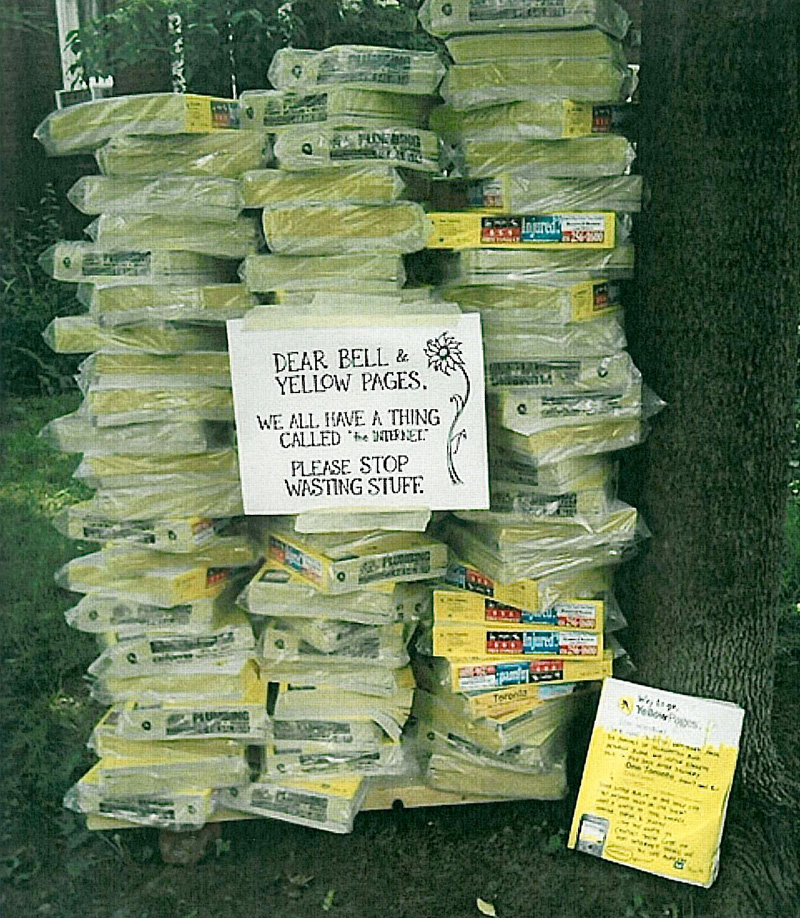
A Blizzard of Action and News on Yellow Pages Waste Reduction

San Francisco and Washington state introduced legislation last week in order to address the environmental and financial impacts that phone books are having in those communities.  The industry has responded by making efforts to improve its current, voluntary, opt-out program.  A central part of these efforts was to create a single clearing house for users who wish not to receive a phone book to go to, instead of the old website which directed users to a phone number of their local distributor after a zip code was entered.  

The new site was launched this week at YellowPagesOptOut.com, and though it was crashed for a day or so, presumably because so many people want out, it appears to be back up and online today.

Here's a round up of the current storm of phone book waste reduction news.


San Francisco’s Opt-In Legislation and an accompanying news piece.

An article on the industry's efforts.

Scott Cassel of the Product Policy Institute, a member of the Environmental Paper Network, has written a great article that addresses the phone book issue.

And on Gizmodo.com, this blogger let's us know how he really feels, in the posting, "At Last, You Can Send the Yellow Pages to Hell"

And if you don't feel like reading, here's an ABC News video segment:


Friday, January 14, 2011

New U.S. Congress May End Mandatory Daily Printing of Legislative Bills

Roll Call, the newspaper of Capitol Hill, reported yesterday that Representative Chris Lee, a Republican from New York, has introduced legislation that would end the mandatory printing of legislative bills by the Government Printing Office (GPO).

This legislation, if enacted, could save the government between $25 and $35 million dollars over the next decade.  And by eliminating the redundancy of automatically having the bills published online, and in print, it would significantly help reduce the daily environmental footprint of the Congress.

The Government Printing Office serves a vital role to the functions of Congress, but there are many common sense opportunities, such as this, to use resources more efficiently.

Currently, according to long-standing practice, the GPO ensures that each sponsor and co-sponsor of every bill receives at least 5 hard copies of proposed legislation, regardless of the bill's length.  Copies are also delivered to the committee responsible for the bill.

From the article,

"Lee likened the process to the infamous Congressional ice-bucket tradition. Offices used to receive buckets of ice each morning, an unquestioned practice that started “before the advent of the refrigerator” and continued, “although unnecessary” until 1994, Lee said.
“This is the next ice bucket,” he said."
Government leadership on the issue of paper use efficiency is to be welcomed.  It is very intentionally the first pillar of Environmental Paper Network's Common Vision, a roadmap to sustainability in paper production and consumption with broad endorsement.  Many leading corporations are realizing the necessity and benefits as well, such as Sprint, who just announced an ambitious goal to reduce paper use by 30%.   For some good ideas on paper use efficiency and more case studies, download a fact sheet here.

Let's hope that efforts such are these are carefully considered in order to maintain the transparency essential to open government, and embraced and expanded by the new Congress.  

What do you think about this proposal?

Tuesday, January 04, 2011

4th Grader vs. The Goliaths of the Fast Food Industry

Meet Cole Rasenberger, the 10 year old working to protect North Carolina's coastal forests and its wildlife from being devastated by the production of throwaway fast food packaging.

Cole is using money he recently won from a youth action award to "double-down" on his efforts, print more postcards, and fly to Louisville and personally deliver hundreds of them signed by kids in North Carolina, to Yum Brands/KFC.

"My teacher always said....young people do have a voice."


Monday, January 03, 2011

Research: Protected Tree Found in Paper from Indonesia

The Jakarta Post reports that a laboratory study of books purchased in the United States, and originating in Indonesia, has found that some contain the protected Ramin tree. Ramin trees have been protected under the Convention on International Trade in Endangered Species of Wild Fauna and Flora (CITES) since 2003. And the Indonesian government has banned all exports of ramin products.

The study was completed by the World Resources Institute and included in a new report by Greenomics Indonesia titled, Surprise, But No Surprise: Protected Tree Species Find Their Way Into Indonesia Pulp and Paper Products.

The Executive Summary begins,

The recent finding by the World Resources Institute (WRI) that Indonesian pulp and paper products exported to the United States contain Ramin fibers, a protected tree species, means that all  those who produce, handle and trade in such products are liable to criminal sanctions under the United States' Lacey Act.
What's in YOUR paper?

Tuesday, December 07, 2010

PAK 2000 Fails to Meet Its Public Commitments


The luxury shopping bag and packaging company PAK 2000 is back in the Paper Planet news, but this time for very unfortunate reasons.  Readers may recall an announcement that better protection for Indonesia's rainforests was, "in the bag."  At that time, New Hampshire based luxury packaging company PAK 2000 announced that they would cut all financial ties with their majority shareholder, Asia Pulp and Paper (APP), by the end of 2009. 


The commitments were made working closely with Rainforest Action Network (a member of Environmental Paper Network).  In December 2009 RAN wrote to about 100 customers and potential customers of PAK 2000 informing them of the positive commitment and outlining the steps to be taken in the coming year.  Unfortunately, after working over the past year to resolve the situation, RAN has been forced now to communicate once again with those same companies, this time to inform them that PAK 2000 has failed to meet its commitments. The letter also details APP's deception over the past year.

The new letter sent this week to current and potential customers of PAK 2000 by RAN's Executive Director, Rebecca Tarbotton, states....
"In December last year, PAK 2000 made commitments to your company, to RAN and to other customers to sever its connection with Asia Pulp and Paper, stop sourcing Indonesian and other controversial paper and fiber and adopt a best in class paper purchasing policy. I am deeply disappointed to inform you that PAK 2000 has failed to meet these commitments and appears to be unwilling to do so. Because of this, I once again urge you to suspend contact and business with PAK 2000. RAN believes this company is both misleading and continues to contribute to the destruction of Indonesia’s rainforests. 
Since making these commitments last December, PAK 2000’s founder and former CEO Claude Roessiger has been forced out, and control of the company has been taken back by Asia Pulp and Paper (APP) under the leadership of long time APP associate Howard Lo."
the letter describes events over the past year, and concludes by saying...
"Our conclusion is that PAK 2000 is back under APP control and has lied to the staff of PAK 2000, RAN and your company. The transparency and trust that had been growing though our negotiations with PAK 2000 under Mr. Roessiger’s leadership, and that had been a cornerstone of the voluntary agreement reached between PAK 2000 and RAN, have disappeared. Further, PAK 2000 has reneged on their commitments to eliminate controversial fiber by July 2010 and to adopt an FSC preference procurement policy. In fact, as an affiliate of APP, PAK 2000 may lose its FSC chain of custody certification entirely.

Given these developments, RAN can no longer recommend PAK 2000 as an environmentally responsible or reliable business partner. We urge you to eliminate any business you have with PAK 2000 due to the company’s failure to meet its commitments, lack of transparency and links to APP, a company whose history is rife with social, environmental and financial controversy."