Friday, August 17, 2007

New "Field Guide" to Eco-friendly, Efficient and Effective Print

Monadnock Paper Mills has announced the release of the second edition of its acclaimed instructional how-to guide for creating more sustainable print materials. The publication, A Field Guide: Eco-Friendly, Efficient and Effective Print is intended to be a single resource that presents objective information and points out alternatives for design decisions that support sustainability without sacrificing style and impact.

New information in the second edition of A Field Guide includes a full chapter dedicated to packaging, an expanded section on energy and emissions, and an overview of the various environmental programs, logos, and terminology that many paper mills use in their product literature today.


Tuesday, August 14, 2007

Apple and AT&T Team Up to Bring You Forest Destruction

Technology is supposed to make life easier, right? Well in the case of Apple's new iPhone which is the buzz of the techno-geek world right now, it may make browsing the internet better and really be an amazing all in one package, but one thing they certainly did not get right was the billing.

When you sign-up for the iPhone you have to use AT&T and people have been reporting huge stacks of paper in their bills detailing every data transfer, call, and txt that you sent. At first I thought this couldn't be so bad, then I saw this.


300 pages? Are you kidding me? I thought it was a joke until I read all the comments on gizmodo about it and found that she is not alone... come on Apple and AT&T, you can do better!

Friday, August 10, 2007

New York Times Shrinks

NPR reports on the New York Times' shift this week to a format which is 10% smaller than its previous format, expected to save $10 million/year in paper costs, and reduce its environmental impact. The change brings "the newspaper of record" in line with the industry trend.

Smart move. Let's hope the next step is to take a hard look at what forests the remaining virgin fiber content is coming from.

Thursday, August 09, 2007

New Movie: Too Precious to Pulp?

Tasmania's Clean Green Future: Too Precious to Pulp? (Part 1 : Part 2 : Total 17 minutes) systematically outlines the impact Gunns' proposed pulp mill will have on the future of Tasmania, and its environment, economy and community. The film was made by award winning filmmaker Heidi Douglas.

"Just as the film An Inconvenient Truth exposed climate change to community at large, this film will enlighten audiences who are confused about the issues behind the dispute over the proposed pulp mill", she says.

"This new film represents a courageous move by Heidi, a filmmaker who is already being sued by Gunns for half a million dollars for documenting the Tasmanian forest campaign," Geoff Law campaign coordinator for The Wilderness Society said.

I recommend starting your download, stepping away to fix yourself your beverage of choice, and preparing yourself for an emotional roller coaster ride from awe, to disbelief, to anger, to empowered hope. And if you're a visually oriented person like me, the graphics are fantastic and make complicated issues simple and clear.

For more information on this issue visit www.wilderness.org.au/pulpmill

Wednesday, August 08, 2007

Judge stops SFI "certified" loggers

Weyerhaeuser, the massive logging, paper and wood products company, has been injoined to stop logging in endangered species habitat in the state of Washington.

Weyerhaeuser is certified by the so-called Sustainable Forestry Initiative. The SFI is a marketing program devised by and dominated by industry to greenwash the forest products industry in the US. More on that effort here. That a federal judge has to step in to stop logging by a supposedly certified company in endangered species habitat demonstrates, I think pretty clearly, the extremely low bar, or non-existence of a bar, of sustainability demanded by this program.

From this day let it be known: if you buy SFI, you don't know what in the world you are getting, and there's at least a decent chance it will be from unsustainable logging.

RAN's Understory blog has a good post on other current challenges to the SFI in Washington and Maine.

Tuesday, August 07, 2007

New Report: Banks, Pulp, and People

"The aim of our report is to inform financial institutions about the impacts and risks of upcoming pulp investments before decisions are made and contracts are signed", says Heffa Schücking, director of the German environment and human-rights organization Urgewald.

Over the next five years, the global pulp industry is planning to increase its production capacity by more than 25 million tonnes. This capacity increase is unprecedented and would mean a five-fold increase, when compared to the growth rates of the last decade. More importantly, it would mean a dramatic increase in the problems that the pulp sector is already causing for people and the environment in producer countries.

"Pulp mills and the industrial tree plantations that feed them have become increasingly controversial", says Chris Lang, the author of the report Banks, Pulp and People – A Primer on Upcoming International Pulp Projects. "The vast areas of monocultures required to feed modern mills have severe impacts on biodiversity, forests, water, land rights and livelihoods. And pulp mills themselves are among the most polluting industrial facilities, with grave consequences for the health of local communities and riverine ecosystems. Its no wonder, that in country after country, local people and environmental organizations have taken to the streets to protest against these developments", he adds.

The bulk of new expansions are slated to take place in only a few countries: Uruguay, Brazil, Indonesia, Australia, China and Russia. The report gives a detailed description of the impacts of the industry in these countries as well as analyzing the track records of the involved companies.

In order to hold the financiers of the pulp industry accountable, Urgewald has also set up a new website, www.pulpmillwatch.org. It documents the problems caused by the pulp industry's operations and informs the public, financiers and decision makers regularly about upcoming problematic projects.

Monday, August 06, 2007

Finished Harry Potter, Finally Have Time for Posting Again

Don't worry, no spoilers here. This story is well known by now, Harry Potter 7, The Deathly Hallows, was the "greenest book in history". So the Paper Planet had to get a post up about it...even if it is a little late. Go straight to the source of J.K. Rowling's inspiration, at www.marketsinitiative.org, for the real scoop. Grist does a pretty good job with it too and has links to news articles. Bloggers and reporters, get a press kit here.

It just so happened, that SouthernQ and I were visiting people and forests in Tofino, British Columbia on the day of the big release, and were able to score a couple fresh Ancient Forest Friendly, 100% post-consumer recycled paper Harry Potters, published by Raincoast. They look beautiful, and sport a valuable, and sharp-looking, "Ancient Forest Friendly" logo! It was especially meaningful to purchase them in the town where Markets Initiative, in a teeny office at the end of the earth, first launched the effort to facilitate an environmentally responsible book industry in order to save ancient, old-growth forests.

In Tofino today, the Friends of Clayoquot Sound are doing tremendous work to protect the ancient temperate rainforests (and still in that office mentioned earlier). Visit their website to learn more about their work and the spectacular forests that helped play a role in inspiring the now global movement to shift markets to transform the paper industry. With successful examples like Harry Potter, there is hope for places like the priceless, ancient forests of Clayoquot Sound.

Tuesday, July 31, 2007

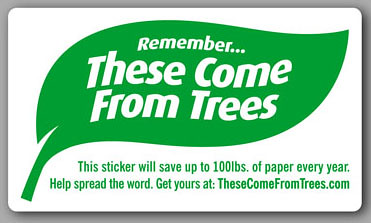
One Sticker That Can Save Thousands of Trees

Speaking of reducing waste....

...These Come from Trees is an inspired "guerrilla public service announcement" started by a concerned individual that is sweeping the nation.

Testing by the creators of the sticker has convinced them that application of the sticker inspires people to think twice, and grab only what they need, resulting in savings of up to 100 pounds of paper every year. Multiplied many times over by the massive opportunites around for placement of the sticker, the savings could be huge.

You can visit the blog of the project to learn more and to order stickers. Get 'em and stick 'em.

Xerox High Yield Business Paper: Costs less trees and $$

A new paper line introduced by Xerox this week reminds us that paper use efficiency is a key piece of any institutions responsible paper purchasing policy. Doing so not only conserves natural resources, it can also reduce organizational costs.

The company released High Yield Business Paper this week, claiming:

"High Yield Business Paper uses 90 percent of the tree versus only 45 percent being used to create traditional digital printing paper. In addition, High Yield Business Paper requires less water and chemicals and is produced in a plant using hydroelectricity to partially power the pulping process. This process reduces fossil fuel use and results in up to a 75 percent reduction in greenhouse gas emissions."
Conservationists agree that buying paper with a high percentage of recycled content whenever possible is the most responsible choice. After this, purchasers should also consider if any virgin content comes from forests certified by the Forest Stewardship Council as sustainably harvested. But the new Xerox line is an innovative step in increasing efficiency, and if companies embrace it for appropriate applications as part of a comprehensive responsible paper use policy, there could be significant net gain for the environment.

For those concerned about performance of mechanically pulped paper in copiers, Xerox says it has overcome problems of some paper in the past:
"Developed by scientists and engineers at the Xerox Media and Compatibles Technology Center, a lab devoted to paper innovation located in Webster, N.Y., the Xerox High Yield Business Paper™ is a mechanical fiber paper that overcomes operational problems, such as curling and dust, which until now prevented mechanical fiber papers from being used with digital print devices."
Another way to save trees and your company's money, is also highlighted this week in Grist. GreenPrint CEO Hayden Hamilton talks about how their software saves your company money, while improving your responsibility profile.

Tuesday, July 10, 2007

Has IP Seen the Light?


In all likelihood the answer to that question is no, but hopefully change is on the horizon...

At the beginning of the month, IP announced that all of their mills in North America are now SFI certified and they are pursuing FSC chain of custody certification.

For those unfamiliar with certification, SFI is a do nothing industry rubber stamp for bad logging practices painted green - allowing destructive practices such as large-scale clearcutting, logging of endangered forests, and the use of toxic chemicals in the management of forests. So, no surprises here. For more information on the pitfalls of SFI visit the Alliance for Credible Forest Certification website.

Whereas this is not really news or bad news, depending on the way you read it, the intent to pursue FSC chain of custody certification could be a good thing. This all depends on whether or not they go all the way and certify all of their land, logging operations and mills or not. I am not holding my breath and it seems Dogwood Alliance isn't either. You can read their response to IP's announcement here.

To read IP's press release on the announcement, go here.

Thursday, June 28, 2007

Buying Paper? Read This First.

Maybe you are a paper purchaser whose company/organization has just adopted a responsible paper purchasing policy, and you're eager to get understandable information on what the issues are. Or maybe your trying to convince your institution to adopt such a policy and be more responsible. The Environmental Paper Network has produced two new topical facts sheets this summer to help paper purchasers make informed decisions about what's in the paper they are buying.

Understanding Recycled Fiber - This fact sheet helps explain why choosing paper with high post-consumer recycled fiber is the smart and responsible choice for purchasers.

Social Impacts of the Paper Industry - This fact sheet focuses on the human impact of fiber sourcing decisions, highlighting responsible and also controversial examples, and provides recommendations to the industry, paper purchasers, and investors.

They are just two of the many resources available at the EPN's website.


Monday, June 25, 2007

Dogwood Alliance Bloggin' from Bonnaroo to the Swamp Forests

Dogwood Alliance has been blogging from across the US Southeast the last couple of weeks and is still on the road to raise awareness of the impacts of over-packaging and the damage it does to US Southern Forests. Check out video from Bonnaroo, the giant summer music festival in central Tennessee, where they spoke to thousands of people from across the US. And this week, they are on the road in coastal Virginia and North Carolina exploring endangered long-leaf pine forests and the amazing coastal swamp forests during the day, and talking to community groups in the evening. The target of their organizing? Yum! Brand Foods, whose ubiquitous and numerous fast food chains (Taco Bell, Pizza Hut and KFC) are turning US Southern Forests into paper packaging without responsible environmental policies in place. Enjoy the video below of interviews at some Yum! fast food restaurants near endangered forests.

Wednesday, June 13, 2007

A Win-Win-Win Paper Proposition for Fortune 500 CEO's

Did you know, that even with a recycling rate above 50%, the U.S. still landfills and incinerates more paper than China even uses as the second largest national consumer? Per capita in the U.S., we use more than 7 times more paper than China. There's a lot of room for improvements in efficiency in paper use, especially in U.S. offices, that can lead to significant cost savings for institutions, not to mention kudos and credit for environmental responsibility.

Enter GreenPrint. This week, GreenPrint Technologies announced an initiative to give away its paper and ink saving software to large organizations in exchange for half of the savings the software creates.

"Because the environmental benefit is so significant, we want to do everything we can to make it as easy as possible for large organizations to use GreenPrint," said GreenPrint CEO Hayden Hamilton. "We also see it as symbolic of GreenPrint's revolutionary proposition – saving money while saving the environment. Has any other company ever offered to pay the Fortune 500 to go green?"

According to studies released by Citigroup and Lexmark, wasted pages account for as much as 25% of all printed material and cost the Fortune 500 over $1 billion a year. Gartner Research estimates 1% to 3% of Fortune 500 revenues are spent on printing costs annually, and those costs are increasing every year. "Each office worker currently uses up to 50 sheets of A4 [printer] paper a day," says Louella Fernandes, Principal Analyst with Quocirca, "and estimates predict office paper consumption increasing by 20% per year on average."

Tuesday, June 12, 2007

Rolling Stone Magazine Paper "Climate Neutral?"

Wenner Media yesterday announced that it is printing Rolling Stone magazine on manufactured carbon neutral paper, a process they claim adds no carbon dioxide to the atmosphere. Beginning with the June 28, 2007 issue which has lengthy coverage of climate issues, Rolling Stone will print on Catalyst Cooled paper, a "planet friendly" option from Catalyst Paper. The claim is achieved through a combination of reduction of greenhouse gas emissions at the mill and offsets purchased through tree planting projects in Canada.

While the moves' intentions drew praise, and a degree of polite applause, the failure to included recycled paper elicited concerns of a missed opportunity from several expert conservation organizations. As the NY Times reports, Frank Locantore of Co-op America's Magazine PAPER Project would have advised them of a different choice. “Are the steps that Rolling Stone is taking good and important ones?” Mr. Locantore asked. “Yes. But what I’m afraid they are doing in the process is diverting attention away from the need to use recycled paper.” He added, “All the evidence shows that the greatest ecological and social benefits come from using recycled paper.”

Likewise, in the Vancouver Sun, Nicole Rycroft of Markets Iniatitive, a leading Canadian conservation group working on paper industry issues had comments as well. "They have reduced the greenhouse gas emissions of this specific mill that produces this paper," she said. "But that doesn't take into consideration the impacts of the forest being cut down to make the paper in the first place."

When asked, Rolling Stone cited concerns about recycled paper's quality. However, other magazines that have switched, such as Fast Company and Inc. which was reported in the Paper Planet this week, demonstrate that is a myth and not a legitimate concern. Mansueto Ventures, which publishes Inc. and Fast Company, announced last week that it had switched both its publications to 100 percent recycled paper and had noticed no slip in quality.

Hopefully, Rolling Stones recent steps in a positive direction will lead to continued improvement of its paper choices. They, and other companies, will find more support if they look to the conservation community's "Common Vision for the Transformation of the Pulp and Paper Industry," which provides consensus guidance on what choices are most important.

Monday, June 11, 2007

Mags and Cats on the Move to Responsible Paper

Last week saw several noteworthy announcements in the coated paper world for recycled content and FSC certified paper.

First, Mansueto Ventures says that beginning with the June issue of Inc. magazine, all Inc. and Fast Company newsstand and subscriber copies will be printed on 100 percent recycled paper. More details here.

Mansueto says that research by the Alliance for Environmental Innovation has shown that each ton of recycled fiber that displaces a ton of virgin fiber used in coated groundwood paper (stock used in magazines) reduces total energy consumption by 27 percent, reduces net greenhouse gas emission by 47 percent, reduces wastewater by 33 percent, and reduces solid waste by 54 percent.

“Printing our magazines on fully recycled paper and being a leader on the environmental front is a great way to reinforce the message we send to our 1.44 million subscribers on working smarter and creating the future of business,” said Mansueto Ventures CEO John Koten. “Doing our part to amplify environmentally responsible magazine publishing and leaving the world a better place is important to the values of our company. We encourage all publishers to do the same.

And second, L.L. Bean, the mail-order company, declined to renew its long-term contract with Verso Paper because it wants paper made under certified sustainable forestry practices that contains more recycled fiber content, the company said.

More and more companies are moving to more responsible paper everyday. What's in your paper?