Friday, February 29, 2008

Positive News for Grassy Narrows Struggle

Addressing longstanding concerns raised by northwest Ontario’s Grassy Narrows First Nation, Rainforest Action Network (RAN), and a coalition of allies, Boise Inc. has notified logging company AbitibiBowater that it will cease purchasing wood fiber logged from Grassy Narrows’ traditional territory in the Whiskey Jack Forest without the Indigenous community’s consent.

According to a letter from Boise to environmental certifiers dated Feb. 27, the company “wishes to honor the request of [Grassy Narrows] Chief [Simon] Fobister to discontinue sourcing fiber from the Traditional Use Area of Grassy Narrows.” Boise’s landmark decision comes just four weeks prior to an expected report from former Canadian Supreme Court Justice Frank Iacobucci on negotiations with the community over the same concerns.

More information and backstory at www.freegrassy.org

Friday, February 15, 2008

Bloomberg Launches ReMix in NYC

Mayor Bloomberg recently announced(VIDEO), from the top of the Empire State Building, the New York City launch of ReMix - Recycling Magazines is Excellent! - a national public education campaign aimed at increasing residential recycling of magazines and catalogs. Beginning next week, ReMix promotions will appear across New York City, in full-page public service advertisements in consumer magazines as well as on buses and subways, in movie theatres, on cable television, and in other outlets.

In explaining some of the reasons for this effort, Mayor Bloomberg speaks plain truth including the fact that "making new paper produces more greenhouse gases than paper recycling."

Unfortunately, amidst this very positive announcement, was something confusing from the head of Hearst Magazines. Cathie Black stated that they were on the fast track to having at least 80% of their magazines coming from forests "certified to a widely accepted third party standard." Well, the only "widely accepted" certification of well managed forests is the Forest Stewardship Council, a fact supported by the consensus of hundred of conservation organizations and numerous studies. But the fact that she did not specify is a signal that they may attempt to deceive consumers by using another certification scheme without the same credibility. Not to mention the fact that she said nothing at all about using recycled paper, which would of course be best of all.

The Paper Planet challenges Cathie Black and Hearst to continue it path to responsibility, which it has made many notable accomplishments in, by adopting a responsible paper policy that includes a high percentage of recycled paper content and gives preference to only Forest Stewardship Council certification forest fiber.

Wednesday, February 13, 2008

Yuck!: Yum! Brands Charged with Forest Destruction in Southern U.S.

Taco Bell and friends better make a run for the green consultant.

The Raleigh News Observer, MongaBay, and many others are picking up the story of how Yum! Brands, the worlds largest restaurant company, is driving the destruction of forests in the Southeastern U.S. by its failure to implement a responsible paper use policy.

Dogwood Alliance can help you take action on behalf of native forests and motivate Yum! Brands by clicking here.

Monday, February 11, 2008

Book Business: The Green Team

A fantastic cover story this month in Book Business Magazine is about how a movement to transform the book industry towards more responsible paper use is growing rapidly and really taking hold, thanks to the encouragement and expert assistance of the Green Press Initiative, and the initiative of some of the biggest book publishers in the world.

This is good news for the public health, the climate, and endangered forests, and part of a rapidly growing movement by corporate purchasers from every sector to "green" their supply chain. Check it out.

The Paperless Home?

The New York Times had an article this weekend on the "paperless home" entitled, "Pushing Paper Out the Door." Make sure to check out the charts and graphs they have as well.

For tips at your place of business to save money by using less paper take a moment to look at the Environmental Paper Network's short fact sheet on Increasing Paper Use Efficiency.

Also, check out, join and tell a friend about a new initiative from Europe called Shrink! that includes a call for people around the world to pledge to use less paper.

Friday, February 08, 2008

Staples Dumps Asia Pulp and Paper

The Wall Street Journal and others reported today that office supply retail giant Staples has canceled its contract with Asia Pulp and Paper (APP) for its continued poor environmental performance and unwillingness to transform itself to meet the needs of its customers.

From the WSJ piece:

"We decided engagement was not possible anymore," Mr. Buckley said. "We haven't seen any indication that APP has been making any positive strides" to protect the environment. Remaining a customer of APP was "at great peril to our brand," he added.

APP representatives didn't return calls seeking comment."

Wednesday, February 06, 2008

Southeastern Swamplands & Paper Packaging

Today, our friends at the Dogwood Alliance released a report, "Southeastern Swamplands & Paper Packaging," that details the world class biological hot spot of the Southeastern coastal forests and wetlands and the growing threat to this region by International Paper and their largest corporate customers. The main product produced by IP in this region is paper packaging and one of the largest customers is the fast food industry including Yum! Brand Foods (KFC, Taco Bell, Pizza Hut and more), McDonald's and more.

In addition to the report, activists held press conferences in Norfolk, VA and Wilmington, NC and presented petitions signed by thousands of citizens calling for protection of the region’s forests.

A quote from the press conference in Wilmington, NC:

“We are here today to shine a bright spotlight on the incredibly diverse forests of the Southeastern swampland and call on International Paper and their big customers to stop the needless destruction of our forests,” said Ruth Morrison, Campaign Organizer for Dogwood Alliance in Wilmington, NC. “The forests of coastal Virginia, North Carolina and Georgia like the Green Swamp in North Carolina and the Great Dismal Swamp in Virginia should not be chopped down, chipped up, and turned into paper packaging for fast food companies like KFC, Taco Bell and McDonalds.”

The Southern Swampland region stretching from the Southeast Virginia coast across the Carolinas to the Georgia coast is an area of amazing natural beauty and unique biological diversity. It is home to unheralded aquatic and plant diversity including such species as the Venus flytrap and longleaf pine trees. Examples of wild natural places in the region that signify what the forests of the region could and should look like include the Great Dismal Swamp National Wildlife Refuge in Virginia and North Carolina and the Croatan National Forest in North Carolina.

To view the press release from today's event, visit here.

To view and download the full report, visit here.

Monday, January 28, 2008

Save Paper Save Money

A new factsheet is available from the Environmental Paper Network that provides both innovative and common sense advice as well as real life business examples of how to save money by reducing paper use. Oh yeah, it lowers your carbon footprint too. Check it out and start saving today.

Friday, January 25, 2008

Catalog Choice Craziness

Okay, I know I post about Catalog Choice too much on The Paper Planet, but its the hottest act in town right now. The latest big boost was a fantastic segment on the Today Show this week where a bunch of 4th graders speak such simple truths you simply can't watch it and then not sign up. The response has been huge and Catalog Choice has now made it possible for over 450,000 people to easily cancel millions of catalogs.


You can see the full YouTube video that these 4th graders in Brookline, Massachussetts made about their school's "Catalog Challenge" by clicking here.

Wednesday, January 09, 2008

Scholastic Announces Environmental Paper Policy

Scholastic, the largest publisher and distributor of children’s books in the world, has joined several of its multinational peers in releasing a strong environmental policy with respect to their paper use. In addition to setting goals for reducing waste and using cleaner manufacturing processes, the policy commits to increasing Scholastic’s use of recycled paper to 25% and increasing the use of Forest Stewardship Council (FSC) certified paper to 30% by 2012.

“Paper consumption has significant impacts on standing forests, climate, biodiversity, and people. Scholastic’s leadership and environmental goals address many of these concerns and adds greatly to the growing change underway in the book industry,” said Tyson Miller, director of the Green Press Initiative. Scholastic’s policy sets the highest bar yet in the book sector in terms of their commitment to using FSC certified paper and this is key given FSC’s strength in protecting key Endangered Forests and the communities tied to them. Given that Scholastic publishes books and educational materials for children, their commitment is also an educational opportunity for future generations that will be reading their books.


Monday, December 17, 2007

Who's Naughty, Who's Nice

For the second year in a row, ForestEthics has published a holiday guide to who's naughty and who's nice in the catalog industry. Catalogs either get a reindeer/caribou, if they are "nice"; a fruitcake, if they're trying to change; or a lump of coal, if they are lagging behind in reducing their environmental impact from paper use.

This month, over 70 actions were held at Sears stores in the US and Canada to raise awareness about the devastating impact on the endangered Boreal Forest of Canada of mailing 425 million Sears catalogs a year. If you're concerned, and wish that Sears would be more responsible, you can send a letter to the CEO, Aylwin B. Lewis, here.

Thursday, December 13, 2007

Change the Margins

In the category of simple, ingenious ideas for everyone to save incredible amounts of paper and protect the environment with a VERY easy action...the winner is... Change the Margins! Its an effort to encourage everyone, and especially a few big corporations, to change their computers default settings in the widely used software program Microsoft Word to smaller page margins. This means more words fit per page - and less paper needed per job. They've even got a petition suggesting Microsoft go ahead and change the default right out the box.

Here a great National Public Radio story on the effort here.

How to Change Your Margins, from the website:

OK, so until we can get Microsoft to change the default margins, here's how to do it on your own. It should take no more than twenty seconds and just a few clicks of the mouse.

On your WORD screen, go to FILE, then PAGE SET UP.

Once on PAGE SET UP, click the DEFAULT key, and you'll be offered "Do you want to change the default settings for the page set up? This change will affect all new documents based on the normal template."

Then set your margins to whatever preferred new width you'd like. I'm suggesting setting each margin to .75" which will save an immense amount of paper.

Thanks for doing this! And I was right, huh? Twenty seconds or so? Not bad...

If you want more specific directions along with screenshots to guide you as you go, check out About.com's margin changin' tutorial.

Friday, December 07, 2007

Green Reading: Barnes and Noble, Hastings Books and Music to Feature Magazines Using Recycled Paper

"Green Paper for People and Planet” Launched at Major US Book Stores by Co-op America’s PAPER Project and Next Steps Marketing

Nearly 400 Barnes and Noble (B&N) and Hastings Books and Music stores nationwide will run in-store promotions highlighting magazines that use recycled paper, under a major push by Co-op America’s Magazine PAPER Project and Next Steps Marketing.

The “Green Paper for People and Planet” promotion will occupy prominent fixtures within these stores with special signage to highlight the magazines’ commitment to the environment. Each publication featured in these unique fixtures is an environmental leader in using recycled paper with at least 30 percent post-consumer content.

Six magazines that use recycled paper – Shape, Fast Company, Mother Jones, ReadyMade, Nickelodeon Magazine, and Body + Soul – will be prominently featured during November in 153 Hastings Books and Music stores. To view Hastings locations nationwide, visit http://www.hastingsentertainment.com/catalog/.

Barnes and Noble has committed to offering 10 slots for magazines that use recycled paper at a heavily discounted rate with special signage in their top 240 stores in January. This promotion will roll out more widely in April 2008 in conjunction with Earth Day.

Tuesday, December 04, 2007

New Green Publishing Blog by Frank Locantore

Folio: Magazine, the premiere industry journal for the magazine publishing industry, has a blog which now features a weekly column on environmental issues in the industry written by Co-op America's Frank Locantore. Check it out, as in his first posting he takes on the recent surge in unverified claims of "carbon-nuetral" paper by several paper companies.

Monday, December 03, 2007

WWF Guide to Buying Paper

WWF International has released a new Guide to Buying Paper. While targeted for a European market, it is relevant to any organization making paper purchasing decisions with social and environmental responsibility. Go Get It Here.

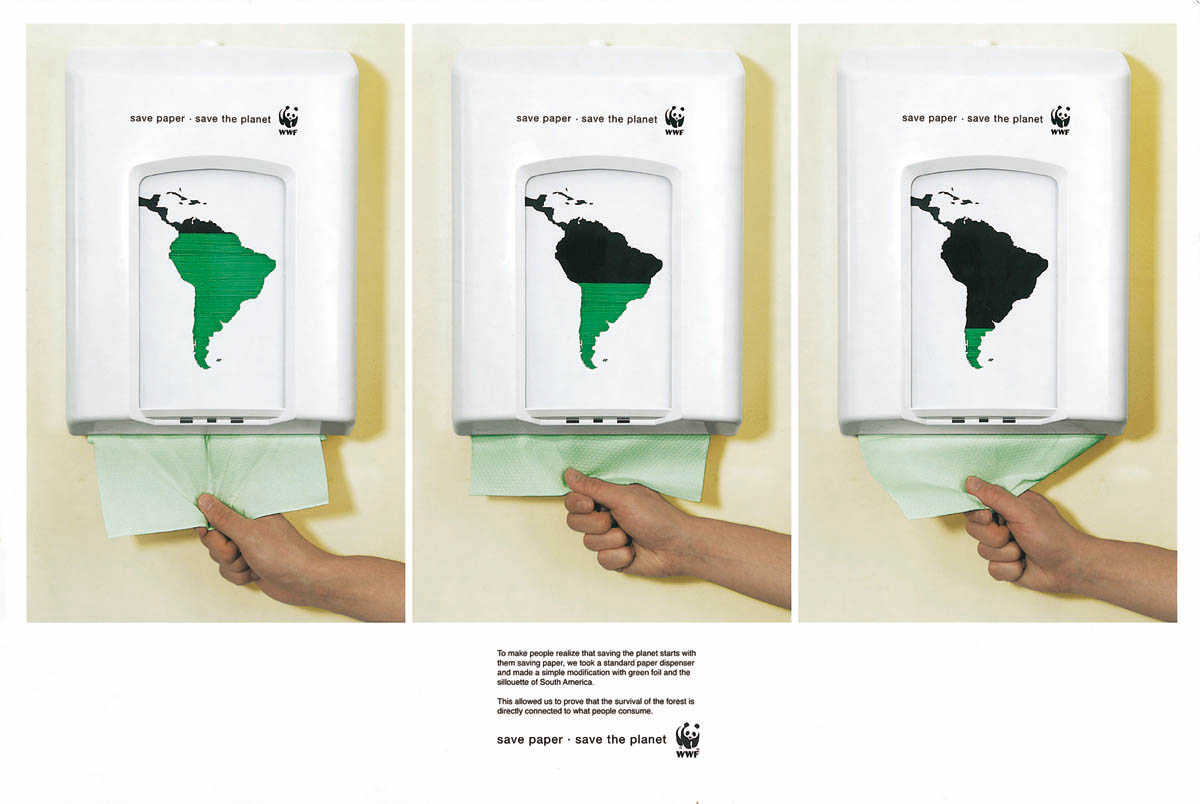
Link to higher quality image: http://www.ibelieveinadv.com/commons/wwfpaperdispenser.jpg