Wednesday, November 26, 2008

Publishers Warned of Future Consumer Revolt Against Paper

Video: Publishers Warned of Future Consumer Revolt Against Paper Video

NEW YORK (AdAge.com) -- On top of all its other current woes, the U.S. magazine business needs to be worried about a consumer backlash against paper-based publishing products. That was the message delivered to the recent American Magazine Conference by Canadian Forest Products Association president Avrim Lazar. He predicted that environmentally-minded Americans will increasingly focus on the connection between the paper-making industry and the problem of global climate change.

Tuesday, November 25, 2008

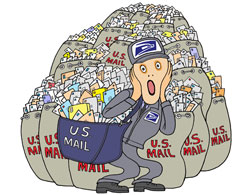
US Postal Worker Punished for Not Delivering Junk Mail

Have you heard about Mailman Steve, the postal worker in North Carolina, USA, who stopped delivering junk mail to the homes on his route? Over almost ten years, Steve Padgett has been dealing with the absurd amount of junk mail by simply not delivering it--and in ten years, not a single person on his route complained.

This is one mailman who is providing people strictly with the service that they want, yet he was sentenced to three years prohibition and must pay $3,000 in restitution.

"Today you'll get credit for a life well lived," U.S. District Judge James C. Dever III told Padgett. Dever could have sent Padgett to prison under federal sentencing guidelines; instead, he put him on three years' probation, fined him $3,000 and ordered him to perform 500 hours of community service.

Check out the whole article in the Raleigh News & Observer and discuss what you think here on the Paper Planet. If you want more entertaining reading on this subject, see a longer article in Slate entitled, "The J. Crew Catalog Destroyed My Spirit: Why Mailmen Give Up.", which shows this is not an isolated incident.
Want to do something in Mailman Steve's honor? Find some resources on this topic at www.donotmail.org and www.catalogchoice.org

Wednesday, November 19, 2008

Junk mail art


An artist in Chicago, Barbara Hashimoto, is producing stunning works of art out of junk mail. Having gathered all the junk mail sent to a small architect's firm during the course of one year, she has shredded it and is using it to create a constantly evolving artwork displayed in the firm's shopfront. Her art responds to the outrageous levels of junk mail in the USA - 77 billion items each year - and its horrific impacts on forests, as highlighted by Forest Ethics' Do Not Mail campaign.

Monday, November 17, 2008

Paper's carbon footprint

The huge scale of the global paper industry's climate change impacts are noted in a Guardian blog by Tony Juniper, former director of Friends of the Earth. He highlights the work of the Shrink project, saying 'Making paper emits three times more carbon than global aviation. The only answer is to consume less.'

Good riddance to Baikalsk Mill


Environmentalists are celebrating the closure of one of the most controversial pulp and paper mills in the world, at Baikalsk, on the shore of Lake Baikal, near Irkutsk, Russia. For more than 40 years this mill, owned by the billionaire Oleg Deripaska, has been pouring effluent polluted with chlorine-based chemicals into the lake. Baikal is the biggest and oldest body of freshwater on the planet, containing 20% of the world's drinking water and many endemic species. Protection of this lake has formed a focus for the environmental movement in Russia, led by Baikal Environmental Wave, which has campaigned tirelessly for the mill to be closed. The failure of an expensive effort to techo-fix the pollution problem has finally led government officials to demand that it shut down operations. It was originally designed to provide 'strategic pulp' to make rayon for parachutes, but this need was superceded by petrochemical fibres before the mill opened in the mid 1960s. Ever since it has produced packaging paper and textile fibres, mostly exported to China.

Wednesday, October 29, 2008

Will the financial crisis slow the pulp invasion?

In the southern Brazilian state of Rio Grande do Sul, eucalyptus pulp producers have been hit by the financial crisis, with currency slumps sending share values plummeting. Three major pulp companies in the region, Aracruz Cellulose, Votorantim Celulose e Papel (VCP) and Stora Enso, have informed the state government that three new pulp mills will no longer go ahead. It remains to be seen whether this will slow the spread of the eucalyptus plantations that were intended to supply fibre to the mills.

It is not surprising that a financial downturn would hit all three companies together as there are already tight links between them. Aracruz and Stora Enso are involved in a controversial joint venture, Veracel, and in September 2008 Aracruz agreed to a merger with VCP to form the world's biggest eucalyptus pulp manufacturer.

Reducing catalogs

We've mentioned before the big impact of junk mail and catalogs on the environment and the huge contribution to climate change. Eliminating catalogs and junk mail is a critical piece of combating climate change. Leeds catalog has apparently taken at least some steps toward this goal. Let's hope that this is expanded and catches on among other catalog companies.

Thursday, October 23, 2008

Greenwash washerman

I'll be looking forward to this regular column in the Guardian Online. If you are not familiar with the Guardian, it is one the UK's national newspapers. Better than most.

The paper industry and energy are two of the most frequent loci of greenwash, so we should be seeing quite a bit linkde from here.

Friday, October 17, 2008

Two Sides, Indeed

The UK National Association of Paper Merchants has launched a marketing program, Two Sides, to

address these criticisms, to educate the paper-buying public of the true facts so they can make informed choices, while at the same time, promote responsible paper use. The key focus is to encourage people to question and challenge their existing wisdom about paper, to counteract the impact of the current environmental lobby against the paper industry, and arrest the guilt surrounding the use of paper.
On their web site, they also say that:

[...] the print and paper industries need to speak with a common voice to dispel the myths and present the real facts.
It doesn't look like they are making much headway in that regard. A Printweek article entitled "Premier Paper contradicts NAPM's campaign to promote paper's image" says, among other things:

Paper merchant Premier Paper Group has gone against the National Association of Paper Merchants' (NAPM) newly launched Two Sides campaign claiming that the paper industry "inevitably consumes precious natural resources" and has a "significant impact" on the environment.
Indeed. Don't forget to visit Shrink and learn how to reduce your paper consumption to a sustainable level.

Forests and Carbon Credits

If true, this is fairly good news:

The European Union should not allow industry to meet climate goals by funding tree planting or cutting deforestation in developing countries before 2020, said a leaked EU Commission paper due for release on Friday.
Many companies and their advocates want to avoid reducing their greenhouse gas emissions by paying developing countries for forest carbon credits, either through planting forests or plantations or through stopping deforestation. We do need to stop deforestation, but this scheme is basically setting up a kind of sub-prime market for carbon credits: trading real, permanent, current reductions of emissions in one place for uncertain and reversible (forests protected now are not guaranteed forever) 'assets.'

As we look forward to a post-Kyoto world, we need to work on both: companies must reduce emissions and become more efficient AND we need to protect and rejuvenate forests in tropical , temperate and boreal regions of the world to get these forests back to storing carbon and getting it out of the atmosphere where it is causing climate change.

Monday, October 06, 2008

Audio: Illegal Logging in the New Yorker

You may have already had a chance to see the fascinating article in last week's New Yorker about illegal logging, the Environmental Investigation Agency, product chain-of-custody and Wal-Mart.

Though the article itself is available by subscription only, you can listen to a fantastic interview with the author, Raffi Khatchadourian, HERE.

UDPATE 10/13: YOU CAN NOW READ THE FULL ARTICLE IN THE NEW YORKER HERE.

In May 2008, the United States Congress passed landmark legislation to address the U.S. market’s role in the global illegal logging crisis, becoming the first country in the world to ban the import of illegally harvested wood and wood products.

If you are interested in how these new amendments to the Lacey Act might affect your company, I suggest this FAQ developed by EIA as required reading. If you import any products or raw material coming from forest products, I suggest you had better be interested, as the penalties for noncompliance will be significant, and the issue is critically important for our economy and our environment.

Thursday, October 02, 2008

Paper Industry Insider Affirms NGO Call for Reform

In an excellent article authored by a major UK paper distributor (Premier Paper Group) and posted to a leading paper industry blog, the case for reform in the industry and more responsible paper purchasing practices is made quite urgently. It is appropriately titled: Paper and the Environment - Confronting an Awkward Reality - An Insider’s View

Here is a snip:

"Paper is a wonderful product but its ecological impact on our planet is already too great and it is growing too quickly. We should all support initiatives which recognise the need to contain this impact such as:

* limiting the overall consumption of paper
* reducing the reliance on virgin fibre from trees
* urging social responsibility in pulp and paper manufacture
* being alert to the potential threats to our environment in the production of wood pulp
* demanding the clean production of both pulp and paper

These are not new proposals: they have been advocated by various environmental organisations for many years. It’s time that we all took them seriously."
True, these are exactly the specific actions being urged by large coalitions of conservation groups in North America, and also in Europe.

Here is another on the topic of recycling's environmental superiority:
"There can be no argument against the recycling of paper. In principle, the process of making recycled paper will save energy, use less water, and reduce the amount of chemicals used when compared with making paper from virgin fibres. For every tonne of paper recovered for recycling, about three cubic metres of precious landfill space will be saved."

Tuesday, September 30, 2008

Joshua Martin, Kelly Sheehan Recognized as Conservation Leaders

The Environmental Paper Network's own Joshua Martin received some much deserved recognition as a “Life Leader” in this month’s New Life Journal, the Southeast region’s healing and natural foods magazine. Check out the article here http://www.newlifejournal.com/oct08/lifes_leaders_joshua_martin_environmental_paper_network.shtml.


Keeping it in the family, Kelly Sheehan (Joshua's wife) was also recognized this month when she was nominated for “Outstanding Leader” at the Roosevelt-Ashe Society’s Conservation Awards and Gala for her work to protect the Southeast’s wild places.


Congratulations to Joshua & Kelly! Cora will be very, very proud -- and when she can talk she will thank you both for protecting the all of the special forests she gets to explore!

Tuesday, September 23, 2008

UVM says 'no' to Kimberly Clark

University of Vermont students have successfully made a change for the better in their bathrooms. A student activist group:


...recently celebrated a public victory by removing all Kimberly-Clark custodial products such as Scott brand toilet paper from campus...
According to the student newspaper, the Cynic.

They have also managed to convince the university to get all recycled products for their 'custodial' needs. Congratulations to them.

Thursday, September 11, 2008

Old Growth Forest Is a Big Carbon Sink

The next time someone tells you that clearcutting forests is a good thing because very young trees absorb more carbon than old growth forests, show them what science says. In a new study, published in Nature, a study analyzing more than 500 forests around the world settles the question once and for all.

When developing a paper procurement policy or organizational climate initiative, its important to take steps to ensure you are not unknowingly contributing to the loss of old growth or the conversion of natural forests to industrial tree plantations. Get ahead of the curve now.