Wednesday, January 24, 2007

Neenah Paper Makes History...Channel, That Is

Neenah Paper will appear tonight, January 24, on the History Channel’s Modern Marvels program during the “Environmental Tech” episode which focuses on recycling. Neenah’s application of sustainable technology at it Neenah, Wisconsin (USA), mill will be featured during the program.

“Neenah Paper recognizes that our industry is one of the most resource-intensive in the world. The manufacturing of paper consumes more water per ton of product than any other manufacturing process,” says Meredith Christiansen, product manager. “Therefore, it’s important as a leading fine paper mill to promote the technological advancements that allow us to recycle the water used in making recycled papers, return 70% of the water to the Fox River cleaner than when it left, and to decrease our dependence on fossil fuels.”

For more information on water quality impacts on the Fox River from the paper industry visit the website of Fox River Watch, a project of Clean Water Action of Northeast Wisconsin, a member of the Environmental Paper Network.

Monday, January 22, 2007

Will Comic Book Publishers Save the Planet?

Real life superheroes from the Activism Center at Wetlands-Preserve in New York City are using their powers to compel comic book publishers to examine the environmental impacts of their publishing choices. As the Comic Foundry reports in an excellent article on the topic, some comic book artists are bounding to action, like Maxeem Konrady who states, "The paper industry is one of the single most serious threats to our clean air, our habitat and our water because it's so stubbornly ingrained."

According to surveys done by the Wetlands-Preserve of dedicated comic books fans, a community with a keen sense of good and evil, a strong majority of them are cheering for eco-justice.

Wednesday, January 17, 2007

Warming Weather Hampers Paper Production in Finland

Warm weather is hampering the harvest of wood for the production of paper in Finland, according to paper maker M-Real. Following one of the warmest year on record, and during an unusually warm winter, the muddy ground in nordic Finland is not hard enough for many forest tracts and stockpiles to be accessed by forestry trucks. The lack of frozen ground is therefore hampering the supply of wood fiber for paper production.

"The company is living from hand to mouth with its wood supply. Possibly we have to limit our (paper) production if the weather does not get colder," said Juha Mantyla, M-real's director for wood sourcing.

Read about it in Planet Ark.

Tuesday, January 16, 2007

...also in Chinese paper news

The Ethical Corporation reports this week that US newspapers are beginning to source newsprint from China for economic reasons, but may be ignoring sustainability in the process.

Tribune, Gannett, and the New York Times are all looking at making a move to newsprint from China, but apparently have failed to analyze the environmental implications of the move despite internal policies that they do so.

A member of The Paper Planet's family of bloggers, Jim Ford of ForestEthics, shows up in the article, urging a closer look at the ethics of the forestry practices where the fiber is being sourced from in Indonesia and Russia.

To China and Back Again Via Nine Dragons

The New York Times Business Section reports today on the story of Zhang Yin of Hong Kong, who built her fame and fortune on recycling U.S. and European scrap paper into the incredible amount of containerboard needed for shipping all those "Made in China" products back to the U.S market. Her company, Nine Dragons Paper, capitalizing on the availability of cheap labor, cheap coal, and cheap land, is set to compete among the largest paper companies in the world in the containerboard sector.

“My goal is to make Nine Dragons, in three to five years, the leader in containerboards,” Ms. Zhang says emphatically in a short interview in her glistening Hong Kong office. “My desire has always been to be the leader in an industry.”

For years, conservation groups have been closely monitoring the growing appetite for paper products in a rapidly developing China and its importing of raw pulp and scrap paper.

The Paper Planet asks you to share your thoughts and links to sustainability information on this subject in the comments section.

Thursday, January 04, 2007

Celebs "Play a Part" for Paper

With help from E! Entertainment Television, an extensive Environmental Media Association Public Service Announcement campaign -- tapping some of film and television's favorite celebrities, the "Play A Part" PSA campaign features celebrities challenging viewers to "Play A Part" by adopting simple changes to their daily routine that will positively impact the health of the environment. The PSAs will air throughout the year on E! and THE VINE @ E!
Online
.

According to press releases and reports on Ecorazzi.com, participating celebrities include: Ed Begley Jr., Kristin Davis, Daryl Hannah, Anthony Kiedis, Wendie Malick, Nicole Richie, Jeffrey Tambor, Wilmer Valderrama, Constance Zimmer, and many others.

Sample EMA PSA tips: Using a reusable mug when purchasing your coffee for the day will help save 13,000 trees per day. Using a reusable nylon grocery bag will help to save the trees required to produce paper supermarket bags (1 tree for every 700 paper supermarket bags).

Tuesday, January 02, 2007

The Packaging Planet

Packaging is one of the largest uses of paper and anyone who has ever opened a box would agree that we live in an overpackaged world, especially when modern paper production is putting severe stress on our natural resources. Recently, Package Design Magazine developed an online supplement to its magazine called "Sustainability by Design," which offers some enlightened advice, time and money saving tools, slick ideas and satisfyingly long lists of resources and links to help accelerate progress on this challenge.

Take a moment to think inside the green box on their homepage.

Plum Creek and Weyerhaeuser Get Called Out

The Washington Post reports that two conservation organizations have independently brought official challenges to the Sustainable Forestry Initiative challenging two of the biggest timber companies with using the misleading "green" label as cover and carrying out unsustainable forestry practices. The Seattle Audubon Society is challenging Weyerhaeuser for logging which threatens spotted-owls in the Pacific Northwest. And the Natural Resources Council of Maine is challenging Plum Creek for unsustainable practices which resulted in previously unreported, and major fines from the state of Maine.

Read the article or access the Alliance for Credible Forest Certification which also has detailed coverage and information on forest certification issues.

Tuesday, December 19, 2006

From Russia with Love and Sustainability?

A coalition of two Russian logging companies, four of the world's largest users of paper products and one of the most important paper producers today released a project report "From Russia . with Transparency" documenting the key success factors in enhancing business practices, labour safety, and sustainable forestry in the Russian forest sector. The report is the outcome of a three-year joint effort to improve environmental and social performance in the Russian wood supply chain.

Together with the Russian partners work was done to improve safety training for forestry workers, introduce new logging technology, apply for Forest Stewardship Council (FSC) forest certification, and implement new guidelines and reporting practices. The work was observed and the findings were reviewed by Transparency International and the Russian Karelian Research Center.

The project partners span the entire supply chain from the Russian forests to international paper and board markets. The Tikhvin-Chalna Project received its name from the communities where the Russian logging companies, Russkiy Les (Tikhvin) and Shuyales (Chalna) are located. The paper producer is Stora Enso and the three publisher partners are Axel Springer, The Random House Group UK, and Time Inc. Tetra Pak represents liquid food and beverage carton manufacturing in the project team.

Grist on Recycled Wrapping

The irreverant online magazine Grist has answers to a seasonal question for environmentalists wrapping gifts this holidays.

A reader ponders, "I'm a proponent of the "reduce, reuse, recycle" philosophy, but during the holidays, wrapping my gifts in the Sunday comics doesn't say "mindful conservationist" so much as it says "I'm too lazy and cheap to use store-bought wrapping paper." Do you have any suggestions on what I can use to show my holiday spirit without using a small forest worth of candy-cane-print wrapping?"

You can read the response in their Ask Umbra section.

Thursday, December 14, 2006

Rice Rejects Kleercuts

The kids at Rice are alright!

Responding to research and advocacy by its students showing how Kimberly-Clark's logging practices were threatening the integrity of the boreal forests of Northern Canada, Houston's Rice University made a big decision this week to end its purchasing of tissue products from the company. The University switched its purchasing to products that include recycled material and exclude material from trees cut from the boreal.

Rice University Sophomore Kyle Saari and other students today delivered a four-foot tall copy of a letter announcing the change in campus purchasing practices to Marc Shapiro, a Houston businessman who is a member of the boards of both Kleenex maker Kimberly-Clark and Rice University. The letter confirmed removal of all Kleenex brand products from the Rice Housing and Dining Department.

The news made the front page of the Houston Chronicle...


Kleercut.net

Tuesday, December 12, 2006

Paper: King of the Landfill


The average US garbage can. Credit: Plenty Magazine

Wednesday, December 06, 2006

Victoria Admits Secret - Pledges to Reform


ForestEthics announced today a major milestone its campaign to transform the catalog industry. Limited Brands, parent company of Victoria’s Secret, revealed a new forest protection policy and a new contract for their catalogs. The policy, unprecedented in its scope, includes several landmark environmental measures and ensures that the pulp for the company’s catalog paper will not come from Endangered Forests. A new paper contract was also signed in accordance with the new policy.

For more than three years, ForestEthics has been educating the catalog industry about its negative environmental impact on the Canadian Boreal. Two years ago, they launched a campaign against Limited Brands/Victoria’s Secret and shortly after began discussions with the company. Since then, Limited Brands has increased their use of post consumer waste (PCW) recycled content, transitioning its clearance catalogs to sustainable paper with 80% PCW recycled content.

New, groundbreaking measures include:

  • Limited Brands has partnered with its paper supplier to eliminate all pulp supplied from the Boreal Forest (Alberta’s Rocky Mountain Foothills) and British Columbia (Inland Temperate Rainforest).
  • Shifting its catalogs to either 10% PCW or at least 10% Forest Stewardship Council (FSC) content during 2007.
  • A preference for Forest Stewardship Council (FSC) certification, the only credible certification for sustainable logging. Limited Brands has partnered with its supplier to shift four of its mills to FSC.
  • Overall catalog paper reduction
  • A commitment to continual improvement on environmental attributes of catalog paper and paper use. Progress will be audited by an independent third party and made public.
  • A commitment to phase out of Endangered Forests
  • One million dollars committed to research and advocacy to protect Endangered Forests and ensure leadership in the catalog industry
For more information, visit ForestEthics webpage.

Tuesday, December 05, 2006

Let Your Fingers Do the Stopping


The Product Stewardship Institute, Inc. (PSI) is undertaking a new project to reduce the tonnage of unwanted telephone books that are generated and distributed to households and businesses. The project also aims to increase environmentally preferable practices related to phone book production and distribution.


PSI was approached by multiple state and local governments that are struggling to respond to consumers’ frustration at receiving so many books, as well as having to pay for their recycling or disposal. They are currently identifying key industry stakeholders to participate in two meetings and work on developing collaborative solutions.

See PSI's phone book web page at: http://www.productstewardship.us/displayPage.php?pageid=339,

and the Project Summary at: http://www.productstewardship.us/displayPage.php?pageid=340.

If you have any questions or comments, contact Carolyn Starrett.


Friday, December 01, 2006

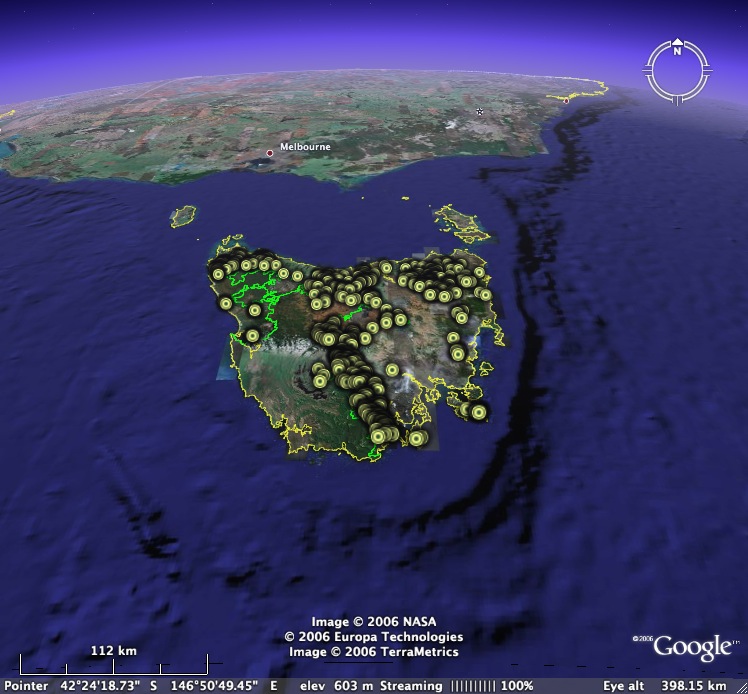
Google Earth-ing Tasmanian Logging

Forest advocates in Australia unveiled a new online tool for demostrating the impact of woodchipping in Tasmania.


The software program is a unique combination of the global satellite imagery program Google Earth and Forestry Tasmania's logging plans, and gives a bird's eye view of the logging year ahead.

For the first time, people the world over can access the virtual reality of proposed logging in Tasmania via the internet. Technological developments now give us previously unseen viewpoints, and linking these to Forestry Tasmania's website provides alarmingly graphic illustrations of the scale of woodchip driven landscape change in Tasmania.

"These images highlight the close proximity of logging operations to The Tasmanian Wilderness World Heritage Area. They also clearly show industrial scale logging and landclearing across the state, especially in the proposed wood supply zone for Gunns' Tamar Valley pulp mill," said Paul Oosting, spokesperson for The Wilderness Society.

The Google Earth program also has a graphic flyover which instantly transports the user from Gunns' export woodchip facilities in Tasmania to the factories of their Japanese customers.

"A trip from a Tasmanian woodchip mill to the yards of Japanese paper makers highlights the reality of the export woodchip industry. Huge piles of Tasmanian native forests lay piled on wharves awaiting export or processing," concluded Mr Oosting.

The program will be available for live access today on The Wilderness Society's website.